The latest edition of Chief Learning Officer magazine contains an interesting article, Time's Up (you can also read the article on the author's blog). It is about Donald Kirkpatrick's Four Level Evaluation Model that was first published in a series of articles in 1959 in the Journal of American Society of Training Directors (now known as T+D magazine).
The author, Dan Pontefract, sums up the article in his last statement, “Diverging from the cockroach, it's time for the learning profession to evolve.” While Dan's article is thought-provoking, I believe it misses out on two points, 1) since it is old, it's no good and 2) it has not evolved.
Old Does Not Mean Outdated
Interaction Design is closely related to our craft, training and learning. While the concept of interaction design has been around for ages, it was not formerly defined until 1990 by Bill Moggridge, co-founder of the Silicon Valley-based design firm IDEO. While it is one of the newer design professions, it still relies on older tools. For example, one of the tools used is the affinity diagram that was developed by Jiro Kawakita in the early 1960s. Thus, being old does not mean a tool should be extinct. If that was true, the cockroach would have disappeared millions of years ago, yet, because it has evolved, it has managed to survive... much to the disgust of anyone who has had their home invaded by them.

enso circle by Vibhav
“Nature itself is full of beauty and harmonious relationships that are asymmetrical yet balanced. This is a dynamic beauty that attracts and engages.” - Garr Reynolds
While people who have had their homes invaded by the cockroach look at them in disgust, entomologists look at them as one of the marvels of natures. Learning/Instructional Designers should not look upon our tools, such as ADDIE and Kirkpatrick's model as disgusting objects that have invaded our craft, but rather more as entomologists look upon the lowly cockroach—marvels of our craft that have survived the test of time.
The Evolution of Our Tools
Just as the ADDIE model has evolved over time, Kirkpatrick's model has also evolved. One of its main evolutionary steps was flipping it into a backwards planning model:
- Results or Impact - What is our goal?
- Performance - What must the performers do to achieve the goal?
- Learning - What must they learn to perform?
- Reaction - What needs to be done to engage the learners/performers?
While I blogged of this in 2008, Flipping Kirkpatrick, Kirkpatrick himself wrote of this several years earlier. This method align's with how Dan's article says we should start, “start with an end goal to achieve overall return on performance and engagement.” In addition, this in no way treats learning as an event, but rather a process. What is interesting, is how closely Kirkpatrick's evolved model fits in with other models, such as Cathy Moore's Action Mapping.
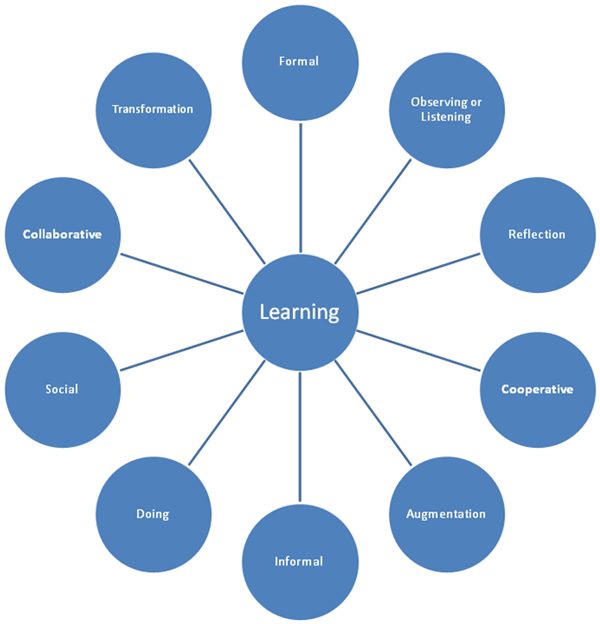
Like the ADDIE model, Kirkpatrick's model is often called a process model. However, this is only true if you blindly follow it. If you remove your blinders and study and play with it, it becomes a way to not only implement formal learning, but informal, social, and nonformal learning as well. For example, in step three, What must they learn to perform?, does not imply strictly formal learning methods, but rather any combination of the four learning processes (social, informal, nonformal, and formal).
How do you see our tools evolving?