Using Gagnè's Nine Steps of Instructional Design as a guide, I created this slideshow to show how it can be used from a constructivist view-point to create a more learner-centered learning environment.


6.16.2010
Instructional Design Toolkit
Deciding I need to tie four instructional design models together (ADDIE, Agile Design, Learning Design and an Extension for ISD), I created this brief description - A Framework for Designing Learning Environments.

6.07.2010
Instructional Design Framework

I added a new section to my Instructional Design site — a Framework to aid in the process for creating learning environments. It is located at Instructional Design Framework. It contains two excel workbooks to aid in the design process. Let me now what you think of it and perhaps what sort of framework you use in your design and development efforts.

5.25.2010
Outlook for the Learning and Training Profession
There is an interesting infographic showing that Education/Training Consultants is one of the Best Jobs in America. It is based on the Bureau of Labor's Statistics Occupational Outlook Handbook, 2010-11 Edition. In fact, if you go to the Bureau of Labor's page on Human Resources, Training, and Labor Relations Managers and Specialists, it reads in part:
Employment is expected to grow much faster than the average for all human resources, training, and labor relations managers and specialists occupations. College graduates and those who have earned certification should have the best job opportunities. Overall employment is projected to grow by 22 percent between 2008 and 2018, much faster than the average for all occupations.
Some of the reasons listed for the projected growth of the learning/training profession includes:
- Workers need to be trained on new legislation and court rulings that revise standards
- Employers are expected to devote greater resources to job-specific training programs in response to the increasing complexity of many jobs and technological advances
- As highly trained and skilled baby boomers retire, there should be strong demand for training and development specialists to impart needed skills to their replacements
But as we all know, the learning/training profession lost a number of jobs due to the recent economic woes — the report even indirectly acknowledges this:
Like other workers, employment of human resources, training, and labor relations managers and specialists, particularly in larger companies, may be adversely affected by corporate downsizing, restructuring, and mergers; however, as companies once again expand operations, additional workers may be needed to manage company growth.
Yet, it seems we sometimes take the biggest hits and are often the last to be called back to the workforce. Why? The biggest reason is that we often fail to directly address problems that impact the organization's performance. Managers in line departments want people who can solve some of their problems. In most cases they are not worried about ROIs or other fancy formulas — they simply want the problem to go away. Every problem that disappears is one less task they have to spend time on. Yet when given some of the simplest training problems we often go astray and rather than delivering a solution, we deliver some cute learning program that offers no real impact.
What are you doing today that shows your real worth to the organization?
5.04.2010
The U.S. Army, Frog Design, & ADDIE: On Design
This is the sixth post in a series on extending ADDIE in order to solve wicked or complex problems:
- Post 1: Innovating With ADDIE
- Post 2: Analysis and Immersion
- Post 3: Design and Convergence
- Post 4: Development and Divergence
- Post 5: Evaluate and Adaptation

I have been doing a series of posts on Design and how ADDIE relates to Frog Design's Immersion, Convergence, Divergence, and Adaptation (ICDA) when Simon Bostock (@BFchirpy) tweeted about the U.S. Army and Design — Design Thinking Comes to the U.S. Army. And what is quite interesting is their five fundamentals of design as outlined in their Field Manual (pdf):
- Apply critical thinking.
- Understand the operational environment.
- Solve the right problem.
- Adapt to dynamic conditions.
- Achieve the designated goals.
What makes it interesting is just like Frog Design's ICDA and ADDIE complimenting each other, the Army's fundamentals of design also fits nicely in:
Click the image for a larger chart
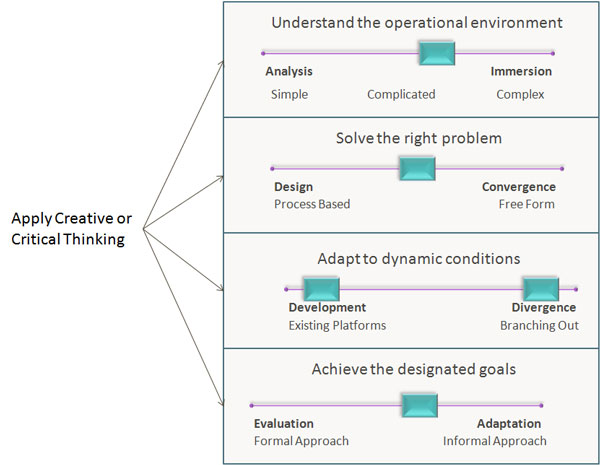
ADDIE is probably the one basic tool that every Learning Designer needs to know and understand because 1) it is a good tool for getting new Learning Designers up and running, 2) no matter what planning and design tool you use to create your learning platforms, you will probably always fall back on some of the steps within ADDIE, and 3) it keeps teams of designers in the loop. However, like any good craftsperson, ADDIE should not be the ONLY tool within your toolkit.
Which has been one of the problems within the Learning Design profession for some time — while there are plenty of Instructional Design tools that can replace parts of ADDIE, there has been few or no Instructional “System” Design tools that make worthy replacements. Frog Design's Solving for Problem X framework with ICDA and the Army's Design Thinking seem to be viable options for extending ADDIE when you are faced with a wicked or complex problem because rather than being composed of a series of steps, which do not work well when facing such problems; they take more adaptive approaches. Thus rather than being a guide for solving problems, ICDA is a tool for innovating, while the Army's Design Thinking is for more complex and wicked problems than ADDIE is normally called for.
In addition, in some organizations innovation has become the end, rather than the means; which means we can have a surplus of innovation. For example, in our own profession we recently had elearning, blended learning, distributed Learning, informal learning, social media, and social learning enter our radar screens, which we have almost treated as ends rather than means for actually accomplishing goals within the organization. Thus, as Adam Richardson writes in his book, Innovation X, our job when working with the organization is “not so much to help its people come up with new innovations as to filter, prioritize, and refine the ones they already have.” Thus our goal is now just as much innovation effectiveness, rather than trying to create more innovations.
When trying to make our innovations more effective, we have to think systems rather than a course or content. For example, the iPod became a great product not because it was a great piece of hardware, but rather because it was a great solution to managing digital music and recordings such as podcasts. And this has been our problem for some time — rather than thinking of the end goal, which in our case is often performance, we often only think in terms such as courseware or learning.
Extending ADDIE with the lessons of Frog Design and the U.S. Army should be of great help as we move on to more complex problems.
4.28.2010
Evaluate and Adaptation
This is the fifth post in a series on extending ADDIE in order to solve wicked or complex problems:
- Post 1: Innovating With ADDIE
- Post 2: Analysis and Immersion
- Post 3: Design and Convergence
- Post 4: Development and Divergence
Evaluation in ADDIE is normally composed of two parts:
- Formative Evaluations: a method of judging the worth of a program while the program activities are forming in order to make on-the-spot corrections.
- Summative Evaluations: a method of judging the worth of a program at the end of its activities (summation), with the focus being on the outcome.
In addition, perhaps the most popular methodology for evaluations is Donald Kirkpatrick's Four Level Evaluation Model.
Frog Design's Adaptation is less of a formal approach and more of a causal approach — "stepping back and looking for new directions to go." Wicked or complex problems often have no clear directions when it comes to improving the initial solution, thus you simply take another crack at it to see if you can add new or better functionalities. Evaluation and Adaptation could be scaled as:

The point that you wound up on the first continuum of Analysis and Immersion will more than likely determine the point that you should be on this continuum. That is, if you are working on a simple to complex problem, then you will normally use an Evaluation technique to check your initial solution (left side of continuum). However, if you are working on a complicated to complex problem (wicked problem), then you will normally be to the right of the scale and thus use Adaptation to check your solution.
Next up, final wrap-up on innovating with ADDIE by using Immersion, Convergence, Divergence, and Adaptation.
4.27.2010
Development and Divergence
This is the fourth post in a series on extending ADDIE in order to solve wicked or complex problems:
- Post 1: Innovating With ADDIE
- Post 2: Analysis and Immersion
- Post 3: Design and Convergence
Development in ADDIE is typically thought of as creating the learning content, products, and services, in addition to selecting the media that will carry or deliver them to the learners. Frog Design defines Divergence as branching out beyond what is normally does in its ecosystem in order to take in a wider footprint that provides a holistic solution:

The Development and Divergence Continuum works differently from both the other two ones:
- In the Analysis and Immersion Continuum the complexity of the environment determines at what point you are on the scale.
- In the Design and Convergence Continuum the goal is to aim for the center of the scale.
While the goal in the Development and Divergence Continuum is to aim for both ends — combine “what works” with “what will make it better."
For example, blended learning is normally considered a combination of elearning and classroom learning. eLearning allows the learners to learn at their own pace, while the classroom portion provides the needed social engagement. The Army has found this to be a superior form of learning and is now moving to a dL (distributed Learning) environment. Note that the “d” is not capitalized as only the “Learning” is emphasized — classroom learning is used when it makes sense.
Another example is the greater consideration of informal and social media when creating formal learning platforms.
Thus, rather than just working from just one point in the scale, Development can often be improved by working from two or more points in the scale.
Up next — Evaluate and Adaptation.
4.23.2010
Design and Convergence
This is the third post of a series on extending ADDIE in order to solve wicked or complex problems:
- Post 1: Innovating With ADDIE
- Post 2: Immersion and Analysis
In the last post I discussed using a mixture of Analysis and Immersion in order to gain insight and understand the shape of the problem. The next step in Frog Design's framework for solving problems is Convergence — the bringing together of everything you learned in the first step in order to integrate things together; or in other words — to create a whole.
Now this is basically what you do with the Design phase of ADDIE, except with ADDIE, it implies a set of steps, such as developing learning objectives, identify the learning steps, developing tests, etc. If we look at the two terms being placed on a continuum it would look like this:

Unlike the Immersion and Analysis Continuum in which the complexity of the environment determines where you would be placed on the scale, the goal here is to aim towards the middle. That is, if you follow the design process too closely, then you might be turning it into a process model as discussed in the ADDIE Timeline that may take all the creativity out of your learning platform; in addition, it may be moving too far away from Agile Learning Design in which 1) individuals and interactions come before processes and 2) you need to respond to change rather than just following a plan.
And if you go too far to the right side of the continuum then you may end up loosing focus of the goals and objectives of the learning platform. Thus, it is a balancing act of determining the correct level of process (design) with the the right of amount of creative freedom (convergence). If you find yourself at one of the extreme ends of the continuum then you need to seriously question if this is really the correct level of both design and convergence that is required for the project you are working on.
One method that will help you from straying too far to the right or left is to use a mapping or graphic technique, such as Cathy Moore's Action Mapping:
The business of design is to make things that people really want: useful, usable, and desirable — Shelley Evenson, associate professor of interaction design at Carnegie Mellon University's School of Design.
Bill Moggridge (2007) wrote that iterative prototyping, understanding people, and synthesis are the core skills of design and that these skills are central to design:
- Iterative Prototyping: successive small-scale tests on variations of a limited function prototype in order to permit continual design refinements.
- Understanding People: having a basic foundation of the cognitive and behavioral sciences.
- Synthesis: applying prior knowledge and skills to produce a new, innovative, or original whole.
The Design in ADDIE and the Convergence in the Framework for Solving Problems may be thought of as a combination of Shelley Evenson's quote and Bill Moggridge's design fundamentals in order to create a holistic solution.
Up next, the Continuum of Divergence and Development.
Reference
Moggridge, B. (2007). Designing Interactions. Cambridge, Massachusetts: The MIT Press.
4.21.2010
The Immersion and Analysis Continuum in Simple to Complex Environments

When presented with performance or learning challenges there is a continuum on how to approach the problem that is composed of analysis on one end of the scale and immersion on the other end.

Allison Rossett & Kendra Sheldon defined Analysis as “the study we do in order to figure things out” (Beyond the Podium: Delivering Training and Performance to a Digital World ). This term is normally associated with the traditional steps of analysis, such as performing a needs assessment, task analysis, and building performance measures.
While on the other end of the continuum is immersion. It is defined by Adam Richardson of Frog Design as “the method of soaking yourself in understanding what the problem is that you are facing in addition to informing the other three parts of the framework.” This can be thought of jumping into the problem in order to understand it, but not being able to use traditional analysis tools or instruments due to the complexity of the problem.
In most learning or performance design situations we don't use one or the other but rather a mixture of the two, thus it is a Sliding Scale Continuum:
For example:
Left of Continuum
Simple problems will be composed mostly of analysis because we have Exemplary Performers that we can use for models. While this is normally one of the easier learning platforms to design, it does have a couple of pitfalls. The first is thinking that since it is fairly easy to design, it is also easy to learn and perform, thus we fail to build practice time into the learning platform. Designers often become so absorbed in their work that they fail to realize how much time they are putting into it, thus they spend weeks working on the task, then think they can transform it into a 30 minute information dump. The second pitfall is failing to support the informal learning that must occur after the formal learning because there is an average of a 1:4 ratio in which one hour of formal learning produces four-hours of informal learning.
Middle of Continuum
As we move to more complicated design environments there is no Exemplary Performers to be found, thus we have to rely on our own understanding of the problem and other experts who have knowledge of the type of problem you are trying to solve. Thus we are moving towards the middle of the continuum:
- We are doing analysis in that we are interviewing experts to create a best practice.
- In addition, we are immersing ourselves into the environment of those most affected by the learning solution in order to complete our understanding of the problem that the experts cannot elaborate on.
Like the simple environment, you will have to watch for the two pitfalls; in addition, in this complicated learning environment you will normally perform more sets of iterations to ensure you get the feedback of those affected.
Right of Continuum
As we move farther to the right on the scale to complex learning design environments there are no Exemplary Performers and few or no experts to draw upon, thus we get most of our information by totally immersing ourselves into the environment of those most affected by the problem in order to “paint a picture of an emergent practice.” This is because as Rittel (1972) discovered — the best experts within these types of environments are those affected by the solution — since they are the only ones to have experienced the complexity of the problem, they are the best experts for helping to improve that environment.
You need to look for solutions that support informal learning. This is because the complexity of such environments normally needs a small seed of formal learning with large nourishments of informal learning.
Performance Model
In addition, a performance model (such as the one shown below and I discussed in this post) acts differently in the continuum of analysis and immersion.

That is, when you are presented with a problem that is mostly on the analysis side of the continuum, the type of performance problem will normally become apparent within a short time and it will be more of a simple nature. However, as the problem starts to move to the immersion side of the continuum, you will find yourself having to dig deeper and longer to discover the true nature of the problem. In addition, rather than being a simple problem, it will normally be composed of several parts that require multiple solutions, such as fixing a process, creating a learning environment, and redesigning work stations.
Next
Thus, when presented with performance problems we have to think along the scale or continuum of Immersion and Analysis, depending upon the complexity of the problem.
In my next post we will discuss the Sliding Scale Continuum of Planning that is composed of Design on one end and Convergence on the other end.
Reference
Rittel, H. (1972). On the planning crisis: Systems analysis of the “first and second generation.” Bedriftsokonomen. No. 8, pp.390-396.
4.12.2010
Innovating With ADDIE
Every few years the theme of “ADDIE must die” pops up on the radar. This would be a good thing except there are always two major flaws in the argument:
- Instructional Designers are misinformed about what ADDIE is — they refuse to believe that the development of a model such as ADDIE is also iterative in nature — their arguments are always about the first iteration of ADDIE. It almost seems as if they want to stick with the practice of waterfall methods.
- They offer no suitable replacement.
To combat the first flaw I have written several posts on ADDIE. I recently combined these posts into an ADDIE timeline with a discussion on the timeline.
I don't have an answer for the second flaw, although I did write a series of articles on Agile Learning Design that can be used to extend ADDIE.
Which brings me to the purpose of this post — I recently listened to an outstanding podcast, Got X Problems? by Frog Design in which they discuss innovation and why are so few organizations are seeing results. In this episode they discuss solving wicked or complex problems from 21st century challenges that defy conventional planning. What struck me about their method is that it almost perfectly aligns with ADDIE, except that you have to approach it from a slightly different mind-set. In the podcast they use a four-step process:
- Immersion — soaking yourself in the problem to harvest customer insights
- Convergence — bringing together all things such as physical, technology, software, and services into a logical design
- Divergence — exploring new advantages
- Adaptation — stay nimble in a fast-moving environment by going in new directions when facing roadblocks — based on learnings
These four mind-sets would map with ADDIE as:
If you need a different mind-set when facing difficult challenges then I encourage you to listen to the podcast. The RSS feed is http://feeds.frogdesign.com/frog-design-blog/design-mind-on-air. The episode is Got X Problems, dated March 15, 2010. The podcast is about 15 minutes long.
Subscribe to:
Posts (Atom)