1.28.2010

The Three Words Your Customer Must Know

Before I dive into the three words I need to clear up two more misconceptions about training first. Why? Because its one of the words.

Jay includes "training" in his of 8 Dirty Words and gives the following reason, "Training is something you do to someone. Learning is something people do for themselves."

Some of the roughest, toughest people in the training profession are U.S. Marine Drill Sergeants. One of their mottos is that they will not give up un a new recruit as long as he or she does not give up on themselves. Even though their training is some of the best in the world, it is not a one-size-fit-all solution, and they realize they can't "do it" to others; but rather the learners must be willing to learn it themselves. They adjust as long as the learners are willing to learn. I cannot "do it" to you; you must be willing to learn yourself.

Daniel Spira commenting on Jay's post (How Not To Sell Learning / Performance / Training & Development Projects), writes

On the flip side, the term “training” does suggest a strong one-way orientation, as in, “Here is the process.  Follow it.”  and in that way, appears to presuppose how a given solution will be delivered, which may or may not fit with the client’s needs. 

Just because I offer training as one solution, does that mean it is the only solution I am allowed to offer? If I am presented with a performance problem and if it is decided that learning is part of the solution and if the learning meets certain requirements, then yes, training just might be the solution.

OK, on to the three words, Training, Education, Development. These three words are important because they tell the customer when they are going to see a payoff (impact or result) and what must be done to achieve the payoff.

Training

Training is learning that is provided in order to improve performance on the present job. This means training is orientated towards the present. And workplace performance is the only measure to determine its success.

Why must your customer know this? If it is decided that training is the solution, then it has to be carried over to the workplace. It does not require fancy ROI's or other fancy measurements but rather that the agreed upon performance is actually being accomplished once the training is performed. This means there must be an immediate impact once the training has occurred and if this impact is not seen then the training failed. Two quick examples.

I trained forklift operations in manufacturing and distribution centers. Note that these forklifts operate differently than cars in that they have no steering wheel but rather joysticks, their braking system is backwards in that you step on it to make it go and release it to make it stop, etc. Once we have completed the training in a safe place the learners are then certified in the actual workplace. I ascertain that the performance is carried over to the workplace. If I don't ensure the impact occurs then that means I did an half-a** job. Its that simple.

I have also trained SQL on AS/400 systems. The training is important because if they fail to do it correctly they can not only get an incorrect solution but may also bring the system to a crawl. Once we have completed the classroom training, the learners return to the workplace and within a set period of time they are required to build three SQL solutions. Before running each solution they send it to the instructional staff to ensure it is correct. If they fail to complete the assignment their SQL privileges are revoked. We ensure performance carries over to the workplace.

Education

Education in organizations differ from education in schools so don't let the following definition confuse you. Education is training people to do a different job. It is often given to people who have been identified as being promotable, being considered for a new job either lateral or upwards, or to increase their potential. Unlike training, which can be fully evaluated immediately upon the learners returning to work, education can only be evaluated when the learners move on to their future jobs or tasks.

Why must your customer know this term? Since there is a delay between the learning solution and the actual performance, then reinforcement has to occur. If no reinforcement is provided then there is a very good chance that performance will decline (we loose what we do not use). Learning professionals and their customers often get themselves into trouble when they provided training solutions to educational learning problems.

For example, an organization is implementing a new system. Sixty-four days before the new system is to be implemented the learners receive their "training." On the day of the new system implemention things turn into a disaster because the workers forgot what they had learned. The only way a training solution would work is if for example the learners are trained on a weekend and the new system is implemented on Monday. Another method is to provide a performance support solution. If it is decided that the only solution is classroom learning and for some reason the learners will not be able to put their new skills and knowledge to immediate use, then it has to be treated as educational learning, which means reinforcement must be be provided during the delay.

Development

Development is training people to acquire new horizons, technologies, or viewpoints. It enables leaders to guide their organizations onto new expectations by being proactive rather than reactive. It enables workers to create better products, faster services, and more competitive organizations. It is learning for growth of the individual, but not related to a specific present or future job.

Why must your customer know this term? Most development solutions require a lot of involvement from everyone involved, to include the leaders and the learning specialists. In addition the payoff (impact or result) is normally not going to be seen for some time.

For example, during my talks with my last three customers (all large organizations) I discovered that they all had wikis, but that that they were all basically barren wastelands. And they all implemented them in basically the same way — a training solution was provided. Again, wrong learning solution for the problem. Development solutions that get solved with training solutions is probably the biggest reason that training gets it bad reputation. For example, in my last post I noted that such programs as spirit-building, inculcation of company history and philosophy, and individual growth were identified as training, thus they failed to provide the proper impact when measured against Kirkpatrick's Four-Levels of Evaluation. The reason they failed does not mean they are bad programs, but rather they were treated as training problems rather than development opportunities.

So do yourself and your customers a favor — know the three terms and know when to use them

1.27.2010

How Learning Professionals Made Training a Dirty Word

"Training is what you do to dogs."

Yea. Right. Tell that to the U.S. Armed Forces who used it correctly to become the finest warriors the world has ever seen.

An author writing for a training magazine pens, "How many times have you heard training directors say: "I need to find a way to assure that what I teach in the classroom is effectively used on the job?" "I would estimate that only 10 percent of content which is presented in the classroom is reflected in behavioral change on the job." Shortly after his article appeared, a peer-reviewed journal cites the magazine and article that the "rhetorical question" appears in as "research has shown that only 10% of training transfer to the job." Not too long after that books and speakers are citing the peer-reviewed article (and each other) as proof that training does not work. Learning professionals applause and are awed by this amazing piece of "research."

Yea. Right. If I knew that only 10% of my efforts paid off I would follow Beck's advice, call myself a looser, and go shoot myself.

Training

Two researchers show that Kirkpatrick's Four-Levels of Evaluation is not effective for evaluating "training." However, rather than actually examining "training" programs, they exam such "learning" programs as spirit-building, inculcation of company history or philosophy, and individual growth. And of course the Four-Levels prove ineffective in evaluating these "training" programs. The learning community is happy — the research has not only shown that "training" does not transfer, but also that our methods for evaluating it are ineffective.

Yea. Right. Kirkpatrick never said that his method was valid for evaluating all learning programs, but rather training programs.

The world is becoming so complex that training is no longer a useful concept, besides past "research" has shown that it is pretty much ineffective. It only works with dogs.

Yea. Right. The aerospace industry is perhaps one of the most complex industries around, yet they are able to survive in this complexity through set processes, which of course must be trained.

Great work learning community! We can now forget about "training" and simply do pure "learning" programs. To show that we are still advancing our profession, what word are we going after this decade?

1.22.2010

Leading Through a Rear-View Mirror

Shortly after posting Metalearning and Learning Styles I glanced through the latest edition of Chief Learning Officer and came to an interesting quote, "Many CLOs believe podcasting is oversold because few people are auditory learners and its no different than cassettes or CDs from the past 15 years." You can read the article at, A Look at the Industry in 2010 (the quote is on the last page, top paragraph).

I find this quite interesting as CLOs should be the thought-leaders in our profession and yet they are following Marshall McLuhan's quote spot on:

The past went that-a-way. When faced with a totally new situation, we tend always to to attach ourselves to the objects, to the flavor of the recent past. We look at the present through a rear-view mirror. We march backwards into the future. - The Medium is the Massage.
Looking Backwards in Time

Rather than looking backwards through a rear-view mirror, they should be looking at McLuhan's tetrad: four laws for looking at our culture and framed as questions:

  • Enhancement or extend: what improved performance does it provide over the old
  • Obsolescence: what does it make passe
  • Retrieval: what new media is pulled from our cultural inventory
  • Reversal: we tend to over-do the new until we run out of benefits and into detriments

Thus, the four questions that should be asked about podcasting are:

What does the technology extend or enhance?

It extends the benefits of dL (distance Learning) by providing the best medium for delivering lectures. See The effectiveness of m-learning in the form of podcast revision lectures in higher education and Turn on your iPod and learn. Note that lectures are an effective means for departing subject matter knowledge and is just as effective as discussions (Dunkin & Barnes, 1985; Kulik & Kulik, 1979; McKeachie, 1962; Ryan, 1969). In addition, the CLOs in the survey are guilty of placing too much stock in learning styles. The question is not "what media should we use for a learning style," but "what method of learning is best for the knowledge or skill that must be acquired.

Podcasts also enhances the device itself in that it is digital and a more versatile package than cassette or CD players.

What does it make obsolete?

Time spent in the classroom can now be spent on interactions and activities rather than listening.

Podcasting, part of the audio digital file family, is already eliminating the need to keep track of extra media, such as cassettes and CDs.

What is retrieved?

Subject matter knowledge.

What does the technology reverse into if it is over-extended?

It reverts into classroom training that is composed of nothing more than lectures. Thus while podcasts may be used strictly on their own in a few select instances, they should normally be used to train the subject knowledge required for a task, in addition to being used with classroom or elearning activities that will actually give the learners the skills to use the knowledge gained with the podcasts.

1.20.2010

Metalearning and Learning Styles

First, I'm sorry for the long delay between postings but I got tied up with a couple of complex projects. Hopefully future postings will be more timely.

One of the elements in the Periodic Chart of Agile Learning is metalearning — being aware of and taking control of one's own learning (Biggs, 1985). However, since most educational and training activities normally teach learners what to learn, rather than how to learn, this is one task that does not come easily for some learners. One method that can help learners increase their metalearning skills is by giving them an insight into the use of perceptional channels (DeSimone, Werner, Harris, 2002).

Perceptional channels are often referred to as "modalities" — a channel by which human expression can take place and is composed of a combination of perception and memory. It is often used in Learning Style theory. While Learning Styles has been written and blogged about a lot lately, normally in response to two papers, Learning Styles: Concepts and Evidence and Learning Styles and Pedagogy in Post-16 Learning, I believe it is going in the wrong direction. Note that the two papers do NOT disprove learning styles as scientific studies can normally only prove what exists, not what does not exist. For example, in one study of verbal and visual learners, magnetic resonance imaging technology actually shows that the brain processes information differently, depending upon a person's learning style.

photo by iStock

Now I'm not advocating that using one's learning style promotes learning, because so far the evidence does not support this, but rather the opposite — the use of one's learning style often hinders or prevents learning. For example, one study found that visual presentation through the use of pictures was advantageous for all adults, irrespective of a high or low learning-style preference for visual images. In addition, it was especially advantageous for those with a strong preference for verbal processing (Constantinidou, Baker, 2002).

This also apples to other types of learning styles. For example, while verbal learners may like to read about something rather than actually try it, they do much better when they actually apply the skills (kinesthetic), rather than reading about it (Matching Teaching Style to Learning Style May Not Help Students).

Rather than teaching learners that knowing and using their personal learning style is best for them, we should be showing them how an over-reliance on one's learning style is actually harmful, thus they need to select the best style or modality for the task on hand. The meta-analysis of educational interventions conducted by (Hattie, Biggs, Purdie, 1996) can help us put metalearning in context with other interventions, which allows us to put our limited resources and efforts into the interventions that have the largest effect sizes:

Intervention Effect size
Reinforcement 1.13
Student's prior cognitive ability 1.00
Instructional quality 1.04
Direct instruction 0.82
Student's disposition to learn 0.61
Class environment 0.56
Peer tutoring 0.50
Parental involvement 0.46
Teacher style 0.42
Affective attributes of students 0.24
Individualization 0.14
Behavioral objectives 0.12 (interesting?)
Team teaching 0.06

While the above chart does not include metalearning, we can use the research of Marzano (1998) who found that approaches that were directed at metalearning, such as setting goals, choosing appropriate strategies, and monitoring progress are more effective in improving learning outcomes than those which simply aim to engage learners at the level of presenting information for understanding and use. Interventions targeted at improving metalearning produced an average gain of 26 percentile points. While there are a few of ways of calculating effect size and percentile points, I believe 26 percentile points would roughly equal an effect size of 0.80. This would place metalearning in the top five interventions:

Intervention Effect size
Reinforcement 1.13
Student's prior cognitive ability 1.00
Instructional quality 1.04
Direct instruction 0.82
Metalearning 0.80
Student's disposition to learn 0.61
Class environment 0.56
Peer tutoring 0.50
Parental involvement 0.46
Teacher style 0.42
Affective attributes of students 0.24
Individualization 0.14
Behavioral objectives 0.12 (interesting?)
Team teaching 0.06

In addition, as we begin placing more emphasis on informal learning, rather than formal and nonformal, metalearning's importance would probably rank even higher in the chart. Using learning styles as a tool to help learners learn-to-learn, rather that an instrument for stereotyping them into using a particular style, could help them to target one or more styles to fit a strategy for a particular learning need. If you are interested, here are two free learning style surveys to help you: VAK and the Learning Style Survey.

References

Biggs, J. B. (1985). The role of meta-learning in study process. British Journal of Educational Psychology, 55, 185-212.

Constantinidou, F. and Baker, S. (2002). Stimulus modality and verbal learning performance in normal aging. Brain and Language, 82(3), 296-311.

DeSimone, R.L., Werner, J.M., Harris, D.M. (2002). Human Resource Development. Orlando, FL.: Harcourt, Inc.

Hattie, J., Biggs, J., and Purdie, N. (1996). Effects of Learning Skills Interventions on Student Learning: A Meta-analysis. Review of Educational Research, 66, 99-136.

Marzano, Robert J. (1998). A Theory-Based Meta-Analysis of Research on Instruction. Mid-continent Aurora, Colorado: Regional Educational Laboratory. Retrieved May 2, 2000 from http://www.mcrel.org/PDF/Instruction/5982RR_InstructionMeta_Analysis.pdf

12.22.2009

What's on Your Holiday Playlist?

My Christmas playlist when I'm not listening to Podcasts:

Christmas Tree

Song Group Album Time
Happy Christmas (War Is Over) The Alarm Starbucks Hi-Fidelity Holiday 3:43
Tchaikovsky: March Andre Previn (Conducting The Royal Philharmonic Orchestra) Starbucks Winterludes 2:27
Tchaikovsky: Coffee Andre Previn (Conducting The Royal Philharmonic Orchestra) Starbucks Winterludes 3:30
Handel: Hallelujah Andrew Parrott Conducting The Taverner Players & Choir Starbucks Winterludes 3:58
Go Tell It On The Mountain Andy Griffith Now That's What I Call Christmas! Vol. 2 [Disc 2] 2:21
Christmas Must Be Tonight The Band Christmas Party 3:37
Little St. Nick The Beach Boys The Spirit of Christmas (Disc 2) 2:00
My Sweet Lord BeBe Winans My Christmas Prayer 5:07
Christmas Eve Billy Eckstine Have Yourself a Jazzy Little Christmas 3:04
Peace On Earth-Little Drummer Boy Bing Crosby & David Bowie The Edge Of Christmas 2:39
Do You Hear What I Hear? Bobby Vinton The Spirit of Christmas (Disc 2) 2:55
Rockin' Around the Christmas Tree Brenda Lee The Spirit of Christmas (Disc 1) 2:05
The Twelve Days of Christmas Burl Ives/Percy Faith,Orchestra,Chorus The Spirit of Christmas (Disc 2) 3:53
Let It Snow! Let It Snow! Let It Snow! Chicago Chicago Christmas What's It Gonna Be, Santa? 3:28
Child's Prayer Chicago Chicago Christmas What's It Gonna Be, Santa? 3:23
Snoopy's Christmas The Clumsy Lovers A Winter's Night 2:50
Frosty The Snowman Cocteau Twins Cool Holiday Notes 2:56
Winter Wonderland Cocteau Twins Starbucks Hi-Fidelity Holiday 2:53
Blue Christmas Collective Soul You Sleigh Me! 3:03
Sleigh Ride Combustible Edison Starbucks Hi-Fidelity Holiday 3:10
Gloria In Excelsis Deo Countdown Orchestra And Singers All Time Christmas Favorites, Vol 1 1:19
Peace On Earth/Little Drummer Boy David Bowie & Bing Crosby Cool Holiday Notes 4:25
Opera Of The Bells Destiny's Child Now That's What I Call Christmas! Vol. 2 [Disc 1] 4:37
Sleigh Ride Diana Krall Starbucks Holiday: Santa Baby '06 3:26
Christmas (Baby Please Come Home) Dion The Spirit of Christmas (Disc 2) 3:47
Silent Night Dresdner Kreuzchor Season's Serenade 3:32
Auld Land Syne The Drifters A Christmas Party 2:15
White Christmass The Drifters The Spirit of Christmas (Disc 1) 2:40
Santa Baby Eartha Kitt Starbucks Holiday: Santa Baby '06 3:26
Feliz Navidad El Vez Christmas Party 2:34
Have Yourself a Merry Little Christmas Ella Fitzgerald Have Yourself a Jazzy Little Christmas 2:56
Rudolph The Red-Nose Reindeer Ella Fitzgerald Starbucks Holiday: Santa Baby '06 2:53
Here Comes Santa Claus Elvis Presley Starbucks Holiday: Santa Baby '06 1:57
I Believe In Father Christmas Emerson, Lake & Palmer Best Of Emerson, Lake & Palmer 3:32
Gloria in excelsis Deo The English Concert Season's Serenade 2:23
Silent Night The Everly Brothers The Spirit of Christmas (Disc 1) 2:54
A Change At Christmas (Say It Isn't So) The Flaming Lips Christmas Party 5:21
The Christmas Waltz Frank Sinatra The Sinatra Christmas Album 3:01
The Christmas Song Frank Sinatra Starbucks Holiday: Santa Baby '06 3:29
A Charlie Brown Thanksgiving George Winston Linus & Lucy - The Music of Vince Guaraldi 2:30
Jingle Bells Jimmy Smith Have Yourself a Jazzy Little Christmas 3:13
The Little Drummer Boy Johnny Cash The Spirit of Christmas (Disc 2) 2:34
Feliz Navidad [Live] José Feliciano Now That's What I Call Christmas! Vol. 2 [Disc 2] 4:56
Joy to the World Judy Collins The Spirit of Christmas (Disc 2) 2:33
December Will Be Magic Again Kate Bush The Edge Of Christmas 4:51
Christmas Reindeer The Knife Christmas Reindeer - Single 5:33
Hallelujah Leonard Cohen Starbucks Hi-Fidelity Holiday 4:39
Merry Christmas, Baby Lou Rawls The Spirit of Christmas (Disc 1) 2:35
Christmas Is Lou Rawls Starbucks Holiday: Santa Baby '06 3:12
Ave Maria Luciano Pavarotti The Spirit of Christmas (Disc 1) 5:07
Wade: Adeste Fideles Luciano Pavarotti; Kurt Herbert Adler: National Philharmonic Orchestra, Wandsworth Boys Choir Now That's What I Call Christmas! Vol. 2 [Disc 2] 3:32
The Christmas Song Mel Tormé Have Yourself a Jazzy Little Christmas 2:48
Caroling, Caroling Nat King Cole Cool Holiday Notes 2:03
The Christmas Song (Chestnuts Roasting on an Open Fire) Nat King Cole The Spirit of Christmas (Disc 2) 3:10
Please Come Home For Christmas Pat Benatar The Edge Of Christmas 3:07
It Doesn't Often Snow At Christmas Pet Shop Boys Christmas Party 3:57
Deck The Halls The Platters A Christmas Party 2:08
Still, Still, Still The Plymouth Music Series Ensemble Singers with Philip Brunelle, celeste Starbucks Winterludes 2:51
2000 Miles The Pretenders Christmas Party 3:41
Thank God It's Christmas Queen The Edge Of Christmas 4:20
Merry Christmas (I Don't Want To Fight) The Ramones The Edge Of Christmas 2:06
Christmas Must Be Tonight Robbie Robertson Starbucks Hi-Fidelity Holiday 4:53
We Free Kings Roland Kirk Quartet Have Yourself a Jazzy Little Christmas 4:47
Pretty Paper Roy Orbison The Spirit of Christmas (Disc 1) 2:46
Little Drummer Boy The Temptations Starbucks Hi-Fidelity Holiday 3:26
Thanks For Christmas Three Wise Men (XTC) Starbucks Hi-Fidelity Holiday 3:53
Have Yourself A Merry Little Christmas Tony Bennett Starbucks Holiday: Santa Baby '06 3:03
Christmas / Sarajevo 12/24 (Instrumental) Trans-Siberian Orchestra Christmas Eve and Other Stories 3:25
Christmas (Baby Please Come Home) U2 A Very Special Christmas, Vol. 1 2:20
Christmas Wrapping Waitresses The Edge Of Christmas 5:23
Do You Hear What I Hear? Whitney Houston A Very Special Christmas, Vol. 1 3:32

12.17.2009

The Periodic Table of Agile Learning

This is the eighth in a series of posts on Agile Learning Design:

I was going to close this series out with a mind or concept map of agile learning but after a few attempts I decided that there must be a better way; besides, been there and done that. So I decided to create a Periodic Table of Agile Learning:

click to open

It differs somewhat from the normal periodic table as the main group is the far left column and then the major themes (sub-elements) of each major element is listed in the row next to it. The columns basically keep to the same theme. Thus it is probably more like a matrix than a true periodic table, but I claim poetic licence.

I hope you enjoy it as much as I did creating it! - Don

12.10.2009

Iterations in Agile Learning Design

This is the seventh in a series of posts on Agile Learning Design:

In traditional waterfall-type projects, learning platforms are developed in lengthy sequential phases. Learning methods and delivery flaws are normally only discovered during the delivery or evaluation phases. Fixing these defects can waste resources and cause delays to the learning platform or process due to the rework required. This is often referred to as the “1 - 100 - 1,000 rule”: if it cost one to fix it in the initial stages of the project, It will cost 100 times more to fix it at the end of the project and up to 1,000 times more to fix it once it is delivered.

Note: ADDIE or ISD is NOT waterfall (see post on topic), unless the users decide to use the tool in this manner.

Using agile methodologies or concepts allow the designers to test the learning platform up-front in order to ensure it is built upon a sound architecture by discovering the risks and alternatives involved during the planning stage, selecting valid learning objects, and then iterating them in a logical fashion.

Iterations are normally performed using two methods:

  • Design Iteration (interpretive) — the iteration is performed to test a learning method, function, feature, etc. of the learning platform to a small set of learners to see if it valid.
  • Release Iteration (statistical) — the iteration is released as a product to the business unit or customer. Although it may not be fully completed or functional, the designers believe that it is "good enough" to be of use to the learners.

A Design Iteration is a micro-technique in that it uses a small set of learners to test part of the learning platform so that you make an interpretation of its effectiveness. This method is normally used for innovative design. A Design Iteration will generally use two types of prototypes:

  • Drawing or print prototypes — uses paper and pencil models. This allows the design to be quickly sketched out so that you can get input from the learners. It normally solicits more input as the learners do not think the design is "locked-in." In addition it is quite versatile as you can add post-it notes to the paper drawing to simulate drop-down menus, dialog boxes, etc.
  • Interactive prototypes — uses a more realistic model of the learning platform. Its advantage is that it gets you closer to where you need to be. In addition, the learners think it is more "locked-in," thus once you have captured their basic needs with the drawing prototypes, they are more hesitate to offer suggestions unless there is a real need for the changes (helps to prevent running in circles with design changes).

A Release Iteration is a macro-technique in that it uses a large set of learners in order to satisfy two requirements: 1) it gets the learning platform out as fast as possible, even though it may not be fully ready; and 2) it allows large scale testing of the platform before it is "polished."

A large and difficult or innovative project might use several Design Iterations and then make a Release Iteration. In turn, this process is repeated until the learning platform is completed.

After Action Review (AAR)

After running the iterations, use After Action Reviews, especially after you performa a Release Iteration, in order to transform deficiencies into actionable items. In addition, ensure you include the learners and their manager(s) in the AAR to ensure everyone is on the same track:

"Many years ago I was asked by a business unit leader to design a project management class with a significant emphasis on budgeting and forecasting. I complied with his request and designed several exercises intended to address this stated need. When the class ran, participants convinced the instructor that because they didn't have to do budgeting and forecasting, there was no need to spend much time on those subjects. Therefore the instructor skipped them. Participants (learners) were happy because they didn't have to learn content they didn't want to learn, and the instructor was happy because his end-of-class evaluations were extremely high. Unfortunately my client was angry. As he explained to me after the class ran, his employees were correct in saying that they didn't do budgeting and forecasting, which is why most of their projects were over budget and delivered late." — Larry Israelite in Lies About Learning.

AARs not only help you get to the root of problems by having the participants discuss the project in a non-threatening environment, but is also designed to help keep the learners, managers, and you on track so that everyone is striving for the same vision.

12.08.2009

Agile Learning Design: Tools for Learners

This is the sixth in a series of posts on Agile Learning Design:

In the last post I discussed some of the various media for delivering learning methodologies and objects. Before moving on to the final concept of "Iteration" in Agile Learning Design, I thought now would be a good time to discuss the tools the learners require for agile learning in a dL (distributed Learning) environment.

The Lava Lamp

Networked Computer

While this may seam obvious to some, we need to realize that a lot of learners in the workplace do not have access to one or to one that is located in an environment conductive to learning.

Learning Management System (LMS)

And this does not mean access to any old LMS, but one in which the learners can easily search and locate the content they need. As Nicole Fougere pointed out in a recent blog post, Aaron Silvers took a show of hands at DevLearn and discovered this seems to be the last thing that we require of a LMS, but if the learners cannot easily use it and dislike using it, then it is absolutely worthless, no matter how many other bells and whistles it may have.

iTunes/iPod (or similar system)

While there is an adverse reaction to providing this set-up to learners in most organizations, podcasting is a proven and viable means of learning. Yes they may listen to music on their iPods, but they also use email, cell phones, and internet services for personal reasons. Lets provide them with the tools they need. To increase the capabilities of the device (mLearning), consider the iTouch.

Yammer or Twitter

For networking between various learning episodes. Note that one study found that 150 followers is the magic number.

A Guide for Managing Learning

Not everything is hi-tech. Perhaps the best guide around is Getting Your Money's Worth From Training & Development A Guide to Breakthrough Learning for Managers and Participants by Jefferson, Pollock, and Wick. This book is conveniently divided into two parts: 1) start at one end for managers or 2) flip the book over and it is for the learners. It is based on perhaps the best book on training: The Six Disciplines of Breakthrough Learning: How to Turn Training and Development Into Business Results.

PDF Reader

For reading and printing PDFs.

What would you include in your learners' toolbox?

11.24.2009

Selection in Agile Learning Design

This is the fifth in a series of posts on Agile Learning Design:

The fourth concept of PODSI (Plan, Orientation, Design, Select, & Iterate) is selecting and developing the learning objects that best promotes learning. However, the selection of the learning objects in Agile Learning Design is not really about SCORM or AICC standards, but rather about providing the best learning environment that supports the Agile ethos — "Solutions that promote and speed the development of learning processes over comprehensive documentation."

This means chunking the contents into the most logical units that promote and speeds the learners' ability to learn and then packaging it into various media that provide the best delivery methods. Thus rather than breaking the material down into the smallest possible objects and tagging it for future reuse, it must be designed with the learners first in mind. A few examples:

Lectures

Lecturing in the classroom is over and if it is not over in your organization then you are wasting company resources. Now that does not mean "lectures" are finished because they can be quite an effective and efficient means to deliver information, ideas, stories, etc. And it does not mean putting them in a Captivate or Articulate elearning program that locks the learners to their desk. Rather it means putting them in an audio file, such as mp3, so that they can be uploaded to an iPod or similar device that allows them to be portable. The research is starting to show this as the best method for delivering them (Science Direct [pdf] or The Independent) and that learners prefer this method (New Scientist).

Reading Material

Rather than putting a lot of text into an elearning program that requires the learners to click the next button 10 to 30 times, put it in a PDF that is more suited for this type of content. This gives the learners several options for viewing it on screen or printing it if they desire, in addition to being able to add sticky notes. PDFs now allow the use of links, videos, and audio that greatly increase their versatility. Yes an elearning program allows you to ask questions as the learners proceed through the "click screens" but you can get just as good or better effects by asking the questions at the beginning of the PDF file (or where needed) so that you "preframe" the learner before they read the material. In one study the learners had a 10 percent better recall when they first tried to retrieve the answer before it was shown to them (see Scientific American - second page).

Question and Answers

A classroom environment allows the learners to ask questions; however, there are good tools that allow you to compensate for this in a dL (distributed Learning [only the L is capitalized]) environment — Twitter (free) or Yammer (if you need a more secure environment). These tools allow learners, instructors, experts, etc. to exchange short questions, answers, observations, etc. Does this mean we are trying to do away with the classroom? Nope...

Classrooms

Classrooms allow the learners to gain skills in task that can not be accomplished in a dL environment. So why not just perform all the learning in the classroom? The two main reasons are learning variability and cost. People learn at different rates, thus they need to be able to train at their own pace in order to master the material. For example, this chart shows the learning variability of a classroom session that was transformed to a dL environment (Sitzmann, Ely, 2009):
Learning variability
In theory, a classroom has to be long enough for the slowest learner to learn if you want them to master the material. In reality, classrooms are normally designed for the average learner, which means a large percentage of learners are wasting their time and another large percentage are not given the time to master the material. Thus the best environment for most learning is not in a lockstep (classroom) environment, but rather in a self-paced dL environment. Secondly, classrooms are normally one of the most expensive media for learning. ISD or ADDIE is often wrongly identified as a classroom creation tool, but as one who was formally trained in it, one of the first things hammered into us was to select a different delivery option if at all possible because of a classroom's lockstep nature and cost. The real reason for the classroom's dominant position are the people and/or organization behind the tool — they fail to stretch themselves to create a self-paced learning environment.

Blended Learning

This does not mean the classroom is dead as there are many things that must be taught in a classroom type setting or safe learning environment. In addition, classrooms actually enhance dL in that a blended learning environment composed of classrooms and dL increase learning by an average of 11% for both procedural and declarative knowledge (Sitzmann, Ely, 2009). There seems to be something almost magical about blending the interactive and social nature of classrooms with the self paced environment of dL. In addition, dL can have a attrition or drop-out rate as high as 20% as it often treats the person as a "lone learner." For example, in an informal learning episode a person will interact with an average of ten people (Tough, 1999). Adding blended learning and Twitter/Yammer provides the social aspect that we need when it comes to learning so that it does not become a lone-learning environment.

Doing

By delivering the pre-learning to the learners, a classroom type environment or similar setting can now be used exclusively for not only the required social interaction but perhaps more importantly for activities that allow the learners to perform (doing). In addition, as our online tools become more powerful, we are able to create activities that allow the "doing" in a dL environment. For example, although this multiplication game is made for schools, it has an interesting engine behind it:
  • html file : This of course is the file your browser opens.
  • Flash file (swf): Shockwave Flash file.
  • xml file: This is the file that the swf app reads. It supplies the "questions" and "answers." If you open it up with a text editor and study it, along with running the game, you will see that you can edit the xml file to create new questions and answers. While I have not tried it, you could probably add images to the questions/answers.
  • Note: You can download the zip file that contains the above three items.
It's the xml file that is the most interesting because rather than having to edit the flash file, a Learning Designer with a little training could edit the xml file to update it or rework it for a different learning environment. A few of these types of applications would make a good addition to an elearning development library that allow activities to be rapidly built. Has anyone seen other similar examples or instructions for creating them?

Building objects such as these are faster and easier than trying to incorporate everything into one giant elearning package. In addition, they can be iterated faster and are easier to fix and update. But most importantly, they consider the learners first by targeting their learning needs. Questions? → → http://twitter.com/iopt

References

Sitzmann, T. & Ely, K. (2009). Web-Based Instruction: Design and Technical Issues which Influence Training Effectiveness. Retrieved Nov, 2, 2009: http://webboard.adlnet.org/Technologies/Evaluation/Library/Additional%20Resources/Presentations/ASTD%202009%20Presentation%20Slides.pdf

Tough, A. (1999). Reflections on the study of adult learning. Paper presented at the 3rd New Approaches to Lifelong Learning (NALL) Conference, University of Toronto: Ontario Institute for Studies in Education, Toronto, Canada. Retrieved January 8, 2008 from http://www.oise.utoronto.ca/depts/sese/csew/nall/res/08reflections.pdf

11.19.2009

Designing for Agile Learning

This is the fourth in a series of posts on Agile Learning Design:

Ban Clippy

The third concept of PODSI (Plan, Orientate, Design, Select, & Iterate) is Learning Design to facilitate interactions between humans and content in order to increase performance. It accomplishes "interactions" through the use of "awareness" that not only allows the content to sense and respond to the learners, such as feedback and guiding them to their next learning need; but also allowing the learners to sense and respond to the content; and as was noted during a Twitter conversation (with @usable learning and @Kathysierra), "the awareness should be more like Amazon's Lists rather than Clippy." Note that the definition is based somewhat on Safer's (2007) definition of interaction design.

The Texture of Wine

Agile Design captures the texture & nuance of learning

Almost anyone can produce content but it takes a good Learning Designer to add awareness. It is also contextual in that it facilitates specific performance problems under a specific set of circumstances — my solution may not work for a similar problem. The end goal is to produce adaptive, agile thinkers, competent to perform within a dynamic working environment (Mark ley, 2006). While Learning Design is mostly art, it does has best practices.

Learning Design does not align itself with any one medium or technology, rather it is only concerned with the correct technology that aids in the learning/performance solution. Thus, it might be compared to distributed Learning (dL) that relies primarily on indirect communication between learners and instructors that allows the learners to learn at different times, at their own pace, as well as in different places. The old way of spelling the acronym was "DL", however this emphasized delivery method and learning equally, thus the correct acronym is now "dL", which emphasizes Learning without focus on delivery (Markley, 2006). That is, it uses face-to-face instruction when it makes sense.

Techniques to Learning Design

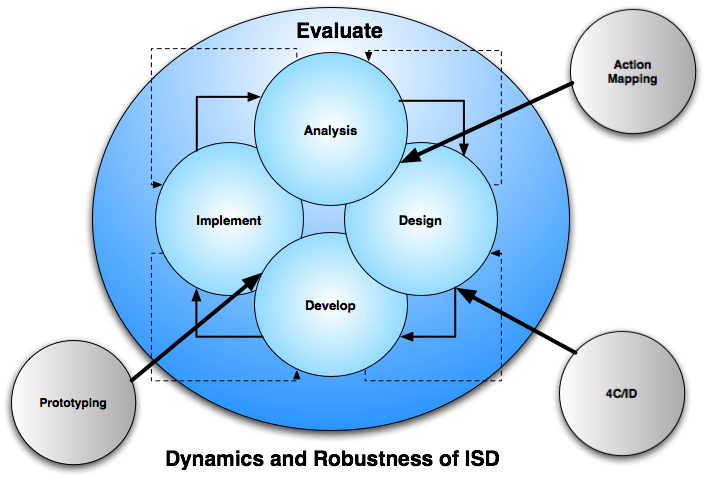
While there are specific methodologies for creating learning or instructional design, such as ISD, ADDIE, and van Merriënboer's 4C/ID Model; there are four design lenses or techniques that provide a means for viewing the overall structure of a specific learning design:

1. Performance-Centered Design

Focuses on the tasks that are composed of actions and decisions that the learners need to perform. A Learning Designer uses an Exemplary Performer as a model and then they build the instructional content and add awareness to it.

2. Guru Design

Focuses on the skills and knowledge of experts (SMEs), in which the designer may or may not be the guru. A Learning Designer uses one or more SMEs as knowledge sources and then they build the instructional content and add awareness to it.

3. Learner-Centered Design

Focuses on the needs and goals of the learners who guide the design; while the Learning Designer aids with the content and awareness. This is somewhat similar to user-centered design that is based on the concept that the people who use a product or service know what their needs, preferences, and goals are, thus they and the Learning Designer collaborate throughout every stage of the Agile Design process to build the content and awareness. It should be noted that the vast majority of so called "Learner-Centered Designs" out there are based on the other three design techniques because they are focused on what others thought the needs and goals of the learners should be, not what the learners thought they should be.

4. System Design

System Design focuses on the system's inputs, outputs, processes, feedback loops, goals, etc. to guide the design.

Specialty Designs (subset)

This includes ISD or ADDIE, which is basically a combination of Performance, Guru, and System Design, but normally little or no Learner-Centered Design (not because the model won't let you, but because the designers fail to). It also includes the micro-instructional designs, such a van Merriënboer's 4C/ID Model that focuses on task specific skills.

"The answer is, there's an infinite number of answers." - Amanda Palmer of the Dresden Dolls

Almost no Learning Design project is accomplished through just one of the four approaches or subsets, but is normally a mixture of them, with one of them being the primary approach to design. For example, a Learner-Centered Design might perform System Design and call on experts or gurus to help with the design; while a Performance Design might include some System Design, in addition to using Merriënboer's 4C/ID for some specialty tasks.

Plug and Play with ISD

So just as you can "plug and play" different tools or methods into ISD, you also plug these tools into an Agile Learning Design so that rather than working with a tool box that only contains a hammer, you work with a full set of tools that compliments the learning platform in order to fast-track and retain learning.

Learning Design Approaches & Orientation

The source of where you get the content (Exemplary Performers, Expert Performers, SMEs, and/or Learners/Performers) as discussed in the last post clues you to the level of complexity of the design environment, which in turn tells you the primary design approach:

  • Exemplary Performers → Simple Environment → Performance-Centered Design
  • Expert Performers → Complicated Environment → Guru Design
  • SMEs & Learners/Performers → Complex Environment → Learner-Centered Design
  • Learners/Performers & managers → Chaotic Environment → System Design

Or which could be pictured as:

Complexity and Design

Click to enlarge

Being able to locate the correct level of complexity of the environment tells you the main design approach to take:

Simple Design Environment - SCR

Sense by using a collaborative process to create shared awareness and understanding of each team member's perspectives in order to create a mental model of the learning problem so that the correct decision-making can be performed.

You know you are in a simple learning design environment when you have Exemplary Performers who role model the required performance while you observe and categorize into tasks, skills, knowledge, and performance steps.

You respond by applying best practices such as creating learning objectives through a series of If/Then statements:

If we want to increase sales of our new service, then the sales representatives need to be able to perform an effective sales presentation. If we want them to perform the presentation, then they need to learn these skills __________, __________, and __________ (skills are categorized by observing the Exemplary Performers role modeling). If they need to perform these skills, then they will require this knowledge __________, __________, and __________ (knowledge is categorized by interviewing the Exemplary Performers role modeling).

This series of If/Then statements can also be visualized by using Performance or Action mapping as Catchy Moore shows in this slide presentation:

Complicated Design Environment - SAR

Sense by using a collaborative process to create shared awareness and understanding of each team member's perspectives in order to create a mental model of the learning problem so that the correct decision-making can be made.

A complicated learning design environment is similar to a simple learning design environment except rather than having Exemplary Performers who you observe, you have SMEs (Subject Matter Experts), who you interview and ask questions in order to analyze their responses.

You then respond by discovering patterns in their responses and transforming the information into good practices. And normally the only way to determine if it is indeed a "good practice" is through a series of iterations. Thus while a simple environment will only require a few iterations, a complicated environment will require several more.

Complex Design Environment - PSR

Since there are no Exemplary Performers to observe or SMEs to interview, the relationship between cause and effect can only be perceived in retrospect, thus the approach is to probe through deep collaboration among the learners, managers, and designers, such as telling stories about what they are experiencing (narratives). It is often helpful to look at the system and processes by starting with the output and working backwards through them in order see what to discuss (collaborate) and if it will help with the solution. Thus the primary design approach is Learner-Centered with the learners fulfilling the roles of SMEs, with perhaps some System Design added in. In addition, you can use a processes similar to the method Joe Deegan describes in his blog post, Project Based Learning in 3 Steps.

This probing effect should start to paint a picture or pattern that allows you to sense an "emergent practice" that can be responded to by designing and then implementing a solution based on the observed pattern. Since this will be a new practice, it will more than likely have to go though several rounds of iterations to arrive at the "emergent" practice.

Chaotic Design Environment - ASR

Since there is no relationship between cause and effect that the team (learners, managers, and designers) can agree upon, you will need to look at the system and processes by starting with the output and working backwards in order see what you can act upon. This might seem similar to a Complex Environment, but with a Chaotic Environment you are basically taking guesses of what to do (perhaps educated ones), while with a Complex Environment you are seeing patterns and getting an "Aha! moment" — this will work.

Once the change has been implemented, sense the environment again and see if the team can now agree upon the correct level of complexity. If not repeat the process with a new "act" until an agreement can be made.

By forcing changes into the chaotic environment you eventually push it into one of the other three domains. At this point a pattern should emerge that will allow the team to correctly identify the environment (more than likely a Complex Environment), thus you can now respond with one of the above three approaches.

The Complexity of Design Approaches

Knowing which design environment you are in helps with the planning by, 1) informing you of the number of design approaches that will be involved, and 2) estimating the number of iterations that will be needed.

1. As the level of complexity increases, the number of design approaches to solve the problem correspondly increases; however, there will normally be one major design approach. This will give you an idea of the scope of the design solution that you will be working in:

Complexity and Design Approaches

2. As the level of complexity increases, the number of iterations to reach a "good-enough" level correspondly increases. This will give you an idea of the number of iterations that will be needed:

Complexity and Interations

Up Next

The design concept creates the basic plan for carrying out the Selection and development of learning objects for a dL platform, which will be covered in the next post. And while selection might seem rather mundane at first, it's more or less the heart of Agile Design.

References

Markley, J., 2006. The Army Distributed Learning Program. Training and Doctrine Command (TRADOC): presentation given at the U.S. Army Courseware Conference March, 14, 2006. Retrieved No, 2, 2009: http://wow.tradoc.army.mil/tadlp/presentations/dlcwconf06.pp3