


6.17.2008
Human Capital Measurement, ADDIE, Nick Carr, Performance, & Education

KnowledgeAdvisors and Bassi Investments' Human Capital Measurement Portfolio Outperforms S&P 500 by 15 Percent - The Earth Times
Organizations that invest heavily in Human Capital were more likely to outperform the market. The Human Capital Measurement portfolio created by Bassi Investments Inc., comprised of a subset of KnowledgeAdvisors clients, clearly shows that when an organization focuses on measuring and improving human capital impact it is more likely to generate above average returns to shareholders.Also see Investing in People who Invest in People (PDF) and The Impact of U.S. Firms Investments in Human Capital on Stock Prices (PDF).
Closing the "ADDIE" Loop - The LeanLearning Blog
Contrary to the belief that the interests of instructional design and learning analytics work at cross purposes, I present the case for analysis-analytics collaboration for the benefit of the learner. Hear me out, ye learned jury of courseware sponsors and learners, before you passeth judgment ...Circling the wagons against Nick Carr - c/net
What is it about Nick Carr, a very bright guy, that inspires the not-so-bright guys to bring out the knives? Criticism of his recent Atlantic piece has ranged from the predictably ungenerous to the downright bitchy.So it goes. The chattering class always gets irritated when convention gets challenged. After Carr published his thoughtful Harvard Business Review article in 2003, "Why IT Doesn't Matter," many technology leaders and trade press opinion makers reacted harshly. They so caricatured Carr's nuanced thesis that they entirely missed his bigger point about IT's declining importance as a competitive asset. In the end, of course, it turned out Carr was quite right.
Alaskan Airlines saves millions by rethinking check-in flow
During my two hours of observation in Seattle, an Alaska agent processed 46 passengers, while her counterpart at United managed just 22.For English Studies, Koreans Say Goodbye to Dad - New York Times
South Koreans now make up the largest group of foreign students in the United States (more than 103,000) and the second largest in New Zealand (6,579). South Korean parents say that the schools are failing to teach not only English but also other skills crucial in an era of globalization, like creative thinking. That resonates among South Koreans, whose economy has slowed after decades of high growth and who believe they are increasingly being squeezed between the larger economies of Japan and China.6.09.2008
Training, Innovation, Learning Landscape, Interviews, Outsourcing, & Education

Learning, Training & Development - Defend Thyselves! - Elliott Masie in HR Management
We have an obligation to create an environment where they can learn the skills they need to succeed and we have a critical need to create (and measure) the readiness of this tribe to take on tomorrow's challenges.The context of error - Cognitive Edge
Innovation happens when people use things in unexpected ways, or come up against intractable problems. We learn from tolerated failure, without the world is sterile and dies. Systems that eliminate failure, eliminate innovation.The Learning Landscape Model - Will at Work Learning

It's helpful to have an overall understanding of what we're trying to do in the learning-and-performance profession.
The E-learning Ecosystem in organizations - The E-learning Curve at Edublogs
By adapting the well-known learning curve, I developed a conceptual model that maps Bloom's Taxonomy of Learning Objectives to learner requirements as they progress along the curve.Behavioral Interview Techniques - testreadypro.com
STAR is an example that is most often used for behavioral interview responses. It follows the following formula, S: Situation, describe briefly when and where the incident occurred and who was involved. You are setting the scene. T: Task, what were you trying to achieve, what was the problem or issue to be dealt with. A: Action, what action did you take independently or to assist others to get to a positive outcome. R: Result, what was the outcome of your actions, state your success and any positive feedback received or what you learned if the outcome was different to what was anticipated.Inside Outsourcing - Forbes
As the risks of outsourcing loom ever larger, the rewards are growing, too. For visionaries who take advantage of its potential, there is real profit at stake.U.S. Schools: Not That Bad - Business Week
"But things aren't as dire for U.S. students as they might appear in the documentary. As an academic, I have been researching engineering education and have taught many graduates of Indian, Chinese, and American universities. It can take longer for Indians and Chinese to develop crucial real-world skills that come more easily for some Americans. Yes, U.S. teens work part-time, socialize, and party. But the independence and social skills they develop give them a big advantage when they join the workforce. They learn to experiment, challenge norms, and take risks."5.28.2008
Training, mLearning, eLearning, Pay, & Blogs

Management in formation - People Management
Inside one of the buildings, you might have found the eminent leadership academic John Alban-Metcalfe. He's giving a lecture to an assemble "some of the worst examples of leadership can come at the top of organisations", and citing such sources as Charles Handy while proceeding to debunk the myth of the charismatic leader.Breaking Down mLearning - mLearning Hub
At the highest level we can separate mLearning into learning applied to mobile devices inside the classroom and those outside the classroom. Please note I realize the simple fact that something that is mobile means it could easily move in or out of the "classroom", however there is an important distinction between the two. Also see, iPods for Learning.Teaching in the digital world, part I: technology is not always your friend - Science Blogs
Teaching an on-line course turned out to be as much a learning experience for me as it was for my students. Now, it's time to step back and reflect on what was learned.Six Dangerous Myths About Pay - Conde Nast
Portfolio Off-price clothing retailer Men's Wearhouse pays higher-than-average wages and invests extensively in training. These unusual moves let it reduce turnover and compete on customer service, superior product knowledge, and sales skills - advantages that rivals can't easily copy.Beyond Blogs - Business Week
Workers can fritter away hours on YouTube. They can use social networks to pillory a colleague or leak secrets. That's the downside, and companies that don't adapt are sure to get lots of it.But there's an upside to the loss of control. Ambitious workers use these tools to land new deals and to assemble global teams for collaborative projects. The potential for both better and worse is huge, and it's growing - and since 2005 the technologies involved extend far beyond blogs. So our first fix is to lose "blogs" from our headline. The revised title: "Social Media Will Change Your Business."
5.26.2008
Video Games, mLearning, Activity Centered Design, & Web Users

Video games can make us creative if spark is right - e! Science News
Video games that energize players and induce a positive mood could also enhance creativity, according to media researchers. However, the study also finds that players who were not highly energized and had a negative mood, registered the highest creativity. "You need defocused attention for being creative," said S. Shyam Sundar, professor of film, video and media studies at Penn State. "When you have low arousal and are negative, you tend to focus on detail and become more analytical.""The key is to generate emotion," explained Sundar. "Ideally, a good teacher can energize the class and make them much more emotionally invested through presentations, guest lectures, and group discussions. Video games can help achieve that in an already simulated way."
Create Mobile Websites with Wirenode - Mobile Learning
Wirenode incorporates media and interactivity, which may even be uploaded by the user, and there's even an analytics tool for users who like to see how many visitors/students are checking out their mobile site.Design - Human Centered Design vs Activity Centered Design? - eCube
The "listen to your users" produces incoherent designs. The "ignore your users" can produce horror stories, unless the person in charge has a clear vision or Conceptual Model for the product. The person in charge must follow that vision and not be afraid to ignore findings. Yes, listen to customers, but don't always do what they say.Web users 'getting more selfish' - BBC
Instead of dawdling on websites many users want simply to reach a site quickly, complete a task and leave. Success rates measuring whether people achieve what they set out to do online are now about 75%, said Dr Nielsen. In 1999 this figure stood at 60%. The designs have become better but also users have become accustomed to that interactive environment.Web users were also getting very frustrated with all the extras, such as widgets and applications, being added to sites to make them more friendly.
5.22.2008
Checking out animoto
Blogging--It's Good for You - Scientific American
Scientists (and writers) have long known about the therapeutic benefits of writing about personal experiences, thoughts and feelings. But besides serving as a stress-coping mechanism, expressive writing produces many physiological benefits.
We're all Einsteins now - New Zealand Herald
The ability to think in abstract terms underpins the scientific, material and, arguably, moral advances of modern society.
Visual Architecture: The Rule of Three - Digital Web

Don't flame me, bro' - New Scientist
People can vastly overestimate their ability to communicate unambiguously by email in that we find it hard to take another person's perspective when communicating electronically. Similarly, a study found that people tend to interpret emails more negatively than other forms of communication, making them even more likely to respond aggressively.
Older Brain Really May Be a Wiser Brain - New York Times
The aging brain is simply taking in more data and trying to sift through a clutter of information, often to its long-term benefit.5.18.2008
Adaptable Workforce, Manufacturing, & Paths vs Hierarchies,

Unlocking the DNA of the Adaptable Workforce - IBM (executive summary)
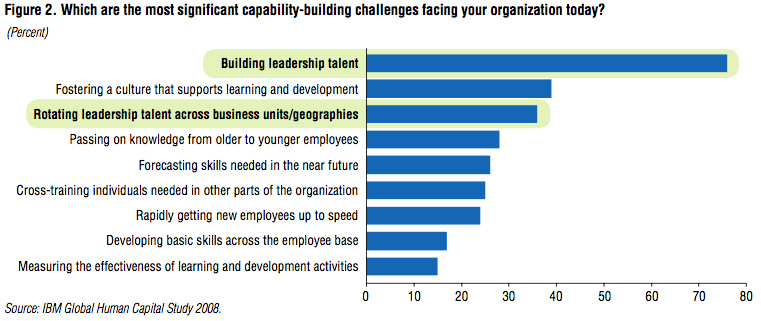
Developing the workforce is the prime ingredient for an organization's success.
"As any firm that has attempted to transform its workforce to meet changing conditions will attest, the journey is difficult and littered with obstacles. Understanding key workforce performance challenges and identifying the leading practices companies are using to overcome them have become central focus areas." - IBM
download the complete paper
Back to Basics - Metropolis
In our rush to build a knowledge economy we forgot that we need a backbone."Manufacturing is still more relevant to long-term economic development than glitzy museums or massive sports stadiums." - Joel Kotkin
Think about paths instead of hierarchies - Signal vs. Noise
While this short post is about web navigation, the same principles apply to all forms of knowledge in the learning and development field."Instead of thinking in terms of hierarchy or up-front structure, I think it's better to work with paths. A path is a line that goes from a starting point A to an accomplishment B." - Ryan
5.17.2008
Development Ratio, mLearning, Change, & Feedback

Recent Survey shows 36:1 development ratio for ILT - Bryan Chapman
- Front-End Analysis (Data Collection, Working with SMEs) = 13% (4.8 hours)
- Instructional Design (Objectives, Outlining, Content Development) = 13% (4.6 hours)
- Lesson Plan Development = 11% (3.8 hours)
- Creation of handout material = 8% (3 hours)
- Student Guide Development = 20% (7.2 hours)
- PowerPoint Development = 21% (7.6 hours)
- Test and Exam Creation = 8% (2.8 hours)
- Other Tasks = 6% (2.3 hours
Mobile learning is not about courses on a phone. mLearning is where we really bring home the message: 'It's not about learning... it's about doing", because while there are learning implications for mobile devices, it's really about performance support.
Can You Become a Creature of New Habits? - New York Times
Researchers in the late 1960s discovered that humans are born with the capacity to approach challenges in four primary ways: analytically, procedurally, relationally (or collaboratively) and innovatively.
What Behavior Do You Want to Change? - Business Week
When we began Nathaniel's exercise, our military friend chose: "When I become less judgmental. . ." as his behavior to change. I was skeptical about his sincerity and thought his participation in the exercise would be interesting to observe. True to my expectations, the first time around he coughed and grunted a sarcastic comment rather than talk about a real benefit.
Research Report on Feedback - Will at Work learning
This seminal research reviews how to give learners feedback, written in a way that puts feedback in perspective, that goes deep into the fundamentals to give readers clear mental models for how feedback works.
5.03.2008
Cognitive Age, Training, Memory, Instructional Technologies, & Captcha

The Cognitive Age - New York Times
We're moving into a more demanding cognitive age. In order to thrive, people are compelled to become better at absorbing, processing and combining information. The globalization paradigm emphasizes the fact that information can now travel 15,000 miles in an instant. But the most important part of information's journey is the last few inches - the space between a person's eyes or ears and the various regions of the brain.
The globalization paradigm leads people to see economic development as a form of foreign policy, as a grand competition between nations and civilizations. These abstractions, called "the Chinese" or "the Indians," are doing this or that. But the cognitive age paradigm emphasizes psychology, culture and pedagogy - the specific processes that foster learning.
Is the grass greener on the other side of the pond? - Training Zone
We're fascinated by the American training scene. Is their training - particularly elearning - bigger, brasher, better? Neil Lasher reports that the USA is just as fascinated by what is happening here! So, is the grass greener on the other side of the pond?
Memory Training Shown to Turn Up Brainpower - New York Times
Although the control groups also made gains, presumably because they had practice with the fluid intelligence tests, improvement in the trained groups was substantially greater. Moreover, the longer they trained, the higher their scores were. All performers, from the weakest to the strongest, showed significant improvement.
Instructional Technologies in Human Resource Development: Impact, Models, and Changes - International Journal of Instructional Technology and Distance Learning
An introduction to instructional technologies that can be used in human resource development (HRD)
Study Suggests Math Teachers Scrap Balls and Slices - New York Times
The students who learned the math abstractly did well with figuring out the rules of the game. Those who had learned through examples performed little better than might be expected if they were simply guessing. The problem with the real-world examples, Dr. Kaminski said, was that they obscured the underlying math, and students were not able to transfer their knowledge to new problems.
We still believe there is human involvement - Nicholas Carr
"Captcha" is the official term for those wavy strings of numbers and letters that you have to decipher before setting up an online email account or gaining access to other types of web sites. The acronym, coined by someone at Yahoo a few years back, stands for Completely Automated Public Turing Test to Tell Computers and Humans Apart.
4.28.2008
Decisions, Design, Wikis, Mistakes, & Innovation

Decision Making: Is It All 'Me, Me, Me'? - Science Daily
People act in their own best interests, according to traditional views of how and why we make the decisions that we do. However, psychologists at the Universities of Leicester and Exeter have recently found evidence that this assumption is not necessarily true. In fact the research shows that most of us will act in the best interest of our team -- often at our own expense.
Down with Innovation - ID Magazine
Design is now so important, it seems, that designers can no longer be trusted with it, and to make it absolutely clear that control has moved into someone else's hands, design needs to be given a fancy new name. Call it design thinking. Call it innovation. Everyone loves design but no one wants to call it design.
No Rest for the Wiki - Business Week
The online tools for building collective info banks are making deeper inroads in corporations and rewriting the rules of collaboration. Although Intel's wiki ruffled feathers - some employees don't like being edited by colleagues, especially those further down the org chart - Intelpedia caught on.
Are You an Enduring Organization? - Bersin & Associates
There was the IBM PC Junior, the RT-PC, the 9370 Minicomputer, and many more. These products, often the results of years of R&D, were announced with flourish and fanfare. When they failed, IBM was clearly disappointed. But the leaders of these products were not fired or demoted - rather they were forced to "learn from these mistakes" and go on and make them better.
The World's 50 Most Innovative Companies - Business Week
The World's Most Innovative Companies, a collaboration with the innovation practice of the Boston Consulting Group, is our most global list ever. It's also determined by a broader set of data than in the past.
Subscribe to:
Posts (Atom)