This post arose from Tom Spiglanin's post and comments on
Revisiting 70:20:10.
70:20:10 has been good in that it has inspired instructional designers to create broader learning experiences, rather than just courses. The major problem is that it is based on how a very small group of one profession believed that is how they learned in the past. Thus, we know the outcome they achieved, 70:20:10, but not how that particular ratio equates to our particular situation.
In addition, we know that 70:20:10 is the goal, but we also know that we don't really have to match the ratio exactly. However, there is no real means that informs us if our percentage is correct or not. For example, if my design is 50:20:30, is it correct for the situation, or did I put too much Training and not enough Experience in it?
Thus, 70:20:10 is predictive in that it tells where or near (it's not exact) we should be, but since it is unstructured, it is impossible to use as a means for getting there. By
unstructured, I mean it does not rely on relationships to track it in an environment. The percentages are only related to each other, thus we cannot associate them with other entities in order to check if our percentage make sense.
In addition, two of the percentages (training and experience) are more closely related to the environment or domain; while the third one, learning from others (social) is more of a learning method, rather than a learning environment. That is, most organizations have different environments for training and working (experience), but none for social learning because it's ubiquitous — it happens all over the place. Thus, the three terms are difficult to align in relationship to each other. And if we can't align them, we cannot structure them.
Structuring the Environments
Training allows us a safe and structured place to learn, while experience allows us to master a task through experiential and experimental methods in the real world. But is there another environment? What about the future? Training and experience gives us the skills and knowledge for performing in today's work environment, but not tomorrow's.
In a rapidly changing world, learning through formal and/or nonformal environments is a required environment if an organization wants to remain competitive. Various elements of
VUCA affect all organizations to one degree or another. Not only do organizations have to be prepared for the elements of VUCA, they must identify future jobs and tasks in order to rapidly meet new and often unexpected challenges. For example, during our latest recession, companies dumped thousands of people in mass layoffs. Now they are whining that they cannot find people who have the education and training that they require. Good organizations should always be planning a path towards the future by educating people to build that path.
What would we call this domain or environment that prepares us for the future? One large organization calls it
Education. In
Human Resource Development, education means learning for a future job. There are actually three terms:
Training is learning that is provided in order to improve performance on the present job. (Full evaluation of the results can be determined when the performer returns to the job)
Education is helping people to do a future or different job. (Full evaluation of the results can only be performed when the performer starts the new job)
Development is helping people to acquire new horizons, technologies, or viewpoints. (Full evaluation of results is often difficult to determine because of extensive ambiguity)
Thus, from this frame of reference, the term
Education and Development would be the best fit — Education covers future jobs, while Development covers the VUCA aspect.
This is not to downplay social learning, as again, it is ubiquitous in all three environments. However, if you really don't like Education or Development, then perhaps the term
Social Learning (learning from others) does fit somewhat as this is what a large majority of the learning is in this type of environment.
Note that the Education environment is similar to Training in that it is often conducted in the classroom, however it differs in two big aspects, 1) the learners choose the objectives and 2) the learning is highly ubiquitous.
So now, we have three domains or environments: Training, Experience, and Education.
Responsibility and Ambiguity
Now we need some type of heuristic to guide us in the selection of the three environments. We do know at least two things about learning:
Responsibility: While learners are responsible for the learning, we at times want to limit the responsibility of how and what they learn because of safety or other concerns that may harm the organization. For example, some mistakes only have minor consequences, while others cause major consequences, thus you want the learning to be more formal in order to eliminate the possibility of that type of mistake, which means you place more of the responsibility on someone who fully understands the task. Thus, responsibility is based a lot on the amount of harm a mistake may cause. This includes such impacts as safety, hits to the organization’s reputation, cost of the mistake, and how it affects others, both inside and outside the organization.
Ambiguity: Some tasks are structured, such as a step-by-step process or procedure; while others are partially or totally ambiguous in the way they are performed. Tasks that have low ambiguity are often shaped that way for a purpose. For example, processes and procedures are often created to ensure compliance or the company has discovered it’s the most effective and efficient way to accomplish a task. Processes and procedures require they be performed correctly, which means you don't want to leave it to chance. Since training relies upon clear objectives as found in processes and procedures, it becomes much harder to train an ambiguous task, thus the Experience environment often works best for learning tasks that are quite ambiguous.
Responsibility and Ambiguity provide two good heuristics because they are about two of the most important entities in a learning situation — the learner and the content that must be mastered.
Full-Spectrum Learning
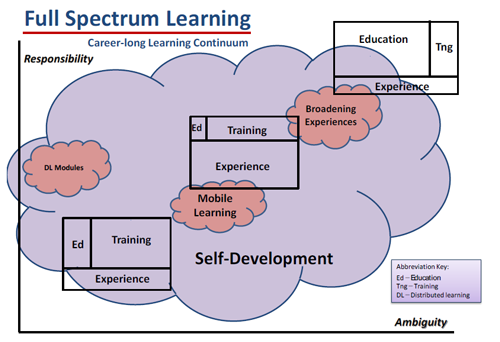
Now we have three environments, Training, Experience, and Education; and two heuristics, the Responsibility and Ambiguity continuums to build our model. However, we are in luck because the U.S. Army has already built such a model:
Integration of the Three Environments
One of the major criticisms of 70:20:10 is that the three environments stand on their own, that is, the three numbers of 70, 20, 10 are normally shown as silos, rather than being integrated. In the model shown above, each of the three environments are shown as being a major domain or environment, depending on where it lies within the matrix, in addition, each major domain is composed of a cluster of blocks that represent the other two environments but to a much lesser extent.
Training
Training is performed when there are low levels of Responsibility and Ambiguity. This is shown in the first cluster of blocks (bottom, left corner) in the above model — a large block of Training, with smaller blocks of Experience and Education.
For example, a forklift can cause serious injury or death, plus extensive damage, thus it needs to be initially learned in a safe environment. Even though you may know the learners are highly responsible, you want to remove some of the responsibility from the learners because of safety. In addition, the basic operations of the forklift are pretty much procedural, rather than ambiguous. Thus, the learning is placed in a training environment.
Once they master the basics, you move them to the next environment — Experience. This allows them to advance from beginner to performer by allowing them to work in an environment that has more ambiguity.
In addition, you might add a small amount of Education, such as also training them on a similar piece of equipment that they might use in the future, such as a
cherry picker.
Note that the example was based on safety, but if a task can damage or harm the organization in any manner, then training should be considered as the primary environment. Equally important, if the task requires a set procedure or process (non-ambiguous), then it also makes a good Training candidate because the task must be performed correctly and not left to chance.
Experience
When the Responsibility of learning is higher for the performer and there is higher Ambiguity in the learning environment, then people often learn best from Experience. However, the learning is still not isolated from Training and Education. This is shown in the second cluster of blocks (middle) in the above model — a large block of Experience, with smaller blocks of Training, and Education.
For example, new supervisors are normally hired because of their success with engaging others. Learning to counsel people has a lot of ambiguity in it, thus while most counseling sessions have a few things in common, the performance of the task is mostly drawn from experience because you cannot rely on set processes to complete the task. Note that in VUCA, the element of ambiguity is largely dealt with by using experimental methods so that cause and effect can be understood. Thus, the majority of their learning is going to come from Experience.
However, since most HR departments will not let you dismiss a person if the paperwork is not correct, then this suggests Training in small amounts, as you do not want to leave it up to chance that the new supervisor learns this process. Another example is that the organization might have a culture in which they look at mistakes as mostly learning opportunities, thus the type of counseling they want to take place may different greatly from the learners' past experiences. This suggests some type of formal learning might be provided to highlight this.
Learning Processes vs Learning Patterns
In the above example, the new supervisors learned a few processes in a training environment to help them perform counseling in an Experience based learning environment. However, there is another learning method that can be used in a training environment if there are no or few processes — pattern learning.
For example, you have a new hire and ask her to create a report. She might make a mistake or two, but there is no real harm to the organization, so she learns it through experience and others. Next, you ask her to create another report, but she has to get the information by joining several tables from a major database that is used throughout the organization. However, if she joins too many tables together at once it could severely slow down the system and affect hundreds of people throughout the organization.
In this case there are no processes to ease the ambiguity of the task, thus this suggests practicing pattern recognition. For example, having the learners practice by solving a number of scenarios so that they start to learn the good patterns from bad ones.
Education
When both Responsibility and Ambiguity are at their highest, they mostly learn from Education, however, the learning is still not isolated from Experience and Training. This is shown in the third cluster of blocks (top, right corner) in the above model — a large block of Education, with smaller blocks of Experience and Training.
As noted earlier, Education is about learning to address the elements of VUCA and prepare for future jobs. This very high degree of Ambiguity marks a significant difference between it and Experience and Training — feedback. With Experience and Training, you get two-way feedback on the actual performance and how it should be performed. Education does not provide the opportunity for feedback until you actually meet one of the challenges (address an element of VUCA or perform a new task or job).
Full-Spectrum Career
Full-Spectrum Learning is not only for the managers and learning designers, but also for the entire workforce to understand:
- The responsibility for learning falls on everyone to varying degrees.
- If they are not seeking and being provided feedback in the Training and Experience environments, then they are not learning. . . they are simply performing and it might be a bad performance.
- Feedback is two-way:
- they are given information about their performance
- they seek answers and resources
- Education is not just for the elites. If you value your employees, then give them opportunities for the future.
Thoughts?
The Full Spectrum Learning model is from
Army Learning Policy and Systems (PDF, pp21-23). The manual only gives a short blurb on the model, so many of the concepts I discussed are my own personal thoughts, thus I would be happy to hear your thoughts on the subject.