8.31.2010

Tools for Analysis

A Learner's Framework — While many analysis methods or tools study the task, this one looks at the needs and behavior of the learners and how they view a particular task.

Analysis Template Book (RTF) — A collection of instruments for performing analysis

Affinity Diagrams — A method for identifying connections among issues and to reveal opportunities for innovation. For examples, see this Google search, for instructions, see this PDF file.

Concept Mapping — A diagram showing the relationships among concepts or ideas. For examples, see this Google search, for instructions, see this site.

Flow Analysis — Identifies bottlenecks and opportunities for functional alternatives. For examples, see this Google search, using Word and Powerpoint to draw flow charts. This method uses Excel.

Various Approaches for Analyzing Tasks and Needs — In a traditional needs analysis, the analyst generates a list of tasks to be performed. This list of tools is designed to be completed by job incumbents, subject matter experts and/or supervisory personnel.

What tools do you have in your toolbox?

8.06.2010

8.04.2010

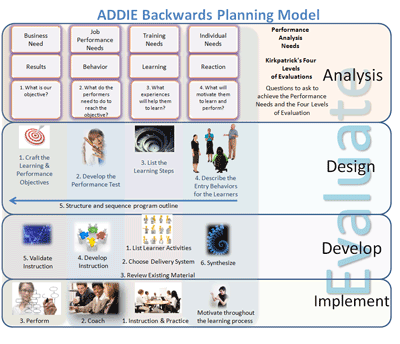
The ADDIE Backwards Planning Model

I have been reorganizing my ISD site and have come up with this ADDIE model:

ADDIE Backwards Planning Model

Click for a larger image

I would be interested in your thoughts.

7.29.2010

We Need Real Examples with Social Learning

The latest podcast from Xyleme Voices, George Siemens on Social Learning Networks: From Theory to Practice is quite informative and thought-provoking; however, it still seems to leave a lot of questions unanswered.

For example, George cites the problem that Apple had with the iPhone's antenna and says it was caused by a people not being connected properly and somehow makes the leap of faith that if the people who knew about it were connected to the others on the design team, such as with social media, then the problem would have been prevented. Yet the problem is much more complex. Any good engineer will tell you that all cellphones that have the antenna inside of them, rather than sticking out, have reception problems because when you put your hand around it, it blocks the signal. But people don't want the antenna sticking out — they want it inside the phone. For example, Nokia jumped in and said their cellphones do not have this problem, yet we have a new Nokia phone in our household and the manual shows you how NOT to hold the phone so you don't block the signal.

Secondly, people want their phones as small as possible, which limits where you can put the antenna. Complicating the problem is that most of the testing was probably done on Apple's campus that gets a good signal as both ATT and Verizon have towers on it; and the problem only occurs in weak reception areas.

Thus we don't know if Apple did not know about the problem or if they knew about it, but decided it was not that big of a problem. The real problem was the way Apple handled the problem as I believe, as some other industry experts, that it was mainly blown out of proportion... after all, we love to jump on big companies.

The real problem is more of the way their public relations people handled the problem. Now could being connected with social media help them perform better, and if so how? That might have been a better and more realistic approach.

The most thought provoking part of the podcast comes about 15:10 minutes into it in which George discusses the need to do a better job of helping the learners learn how to learn (metalearning) rather than just instructing them into what to learn. I also believe that we need to do a better job at this, but we need more realistic examples — the Apple's antenna example just does not cut it.

For example, if I'm designing a course in which the learners need to learn a process to deliver our goods or service, how do I fit social learning and social media in with it? I can see how they help with informal part, but the end of the podcast wants us to a better job with metalearning in our daily training, and this is where we need some real examples.

7.14.2010

Social Learning and Social Media

I recently wrote about bridging the common environment in Social Learning with Social Media tools — Social Learning and Social Media. I would be interested in your thoughts.

Twitter
Tweet This

7.13.2010

15 Years on the Web

This week marks the fifteenth anniversary of Big Dog being on the web! In late 1994 I subscribed to Prodigy as it was one of the first of the early-generation dialup services to offer full access to the World Wide Web. However, a few months later I decided that I did not want to just surf the web, but actually be a part of it. So I then subscribed to NWLink.com and on July 13, 1995, Big Dog went live.
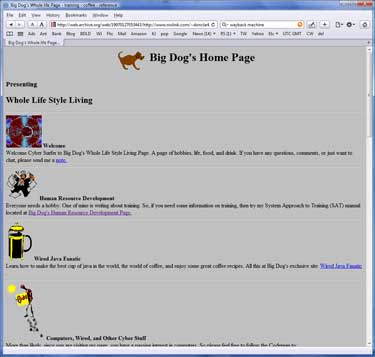
Big Dog 15 years ago

As you can see, my early design skills were somewhat lacking. I did most of my html coding on MS Notepad and except for a few clipart pictures, the drawings were done on MS Paintbrush — really hi-tech stuff.

The main attraction was the SAT or ISD (ADDIE) page. The April 1996 issue of Training Magazine called my site, "The World Wide Web at its best" (April 1996, p.101). Of course it did not take a whole lot to satisfy people back in those early Internet days!
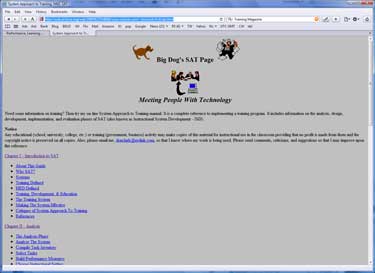
ISD or ADDIE page

In early 1997, the Internet Archive's WayBackMachine started archiving my site. Later that summer I was running out of things to write about so I decided to put my 22 years in the Army to good use and created the leadership page, which is now one of the most popular sections of Big Dog.

Marne Division

One of the questions I'm often asked is, “Why Big Dog?” While serving with the 3d Infantry Division, our company had a saying, “To the Big Dog!”, which basically meant, “We can do it!” The saying was based on a bulldog mascot that was designed by Walt Disney Productions (for the cost of one dollar) as the division commander wanted a visual picture of the song, “The Dog Face Soldier” (clink link to hear the song and learn more about it). The saying meant a lot to me so I used Big Dog as part of my site's name.

In the summer of 1998 I received an email from Big Dogs clothing claiming I was infringing on their trademark and ordered that I remove the name... so I replied to them and told them I had no intention to stop using the name... and of course I am still using Big Dog. My daughter, being the jokester, gave me a couple of Big Dog shirts the following Christmas.

About 8 months later I renamed it Big Dog's Bowl of Biscuits, as my dog, Lazy (who went to the big dog house in Heaven), loved dog biscuits, and a few years ago to Big Dog and Little Dog's Performance Juxtaposition as my small dog (Buddy, a mix of chihuahua and dachshund) wanted to be part of the marquee, along with my Big Dog — Rico, whom I adapted from PAWS.


BuddyRico

A few years back I was starting to run out of server space and exceeding the monthly quota for people visiting/downloading my site, so I got knowledgejump.com from my service provider — hopefully I'm set for a while.


Newest Big Dog page

6.28.2010

Rethinking Gagne's Nine Steps of Instructional Design

Using Gagnè's Nine Steps of Instructional Design as a guide, I created this slideshow to show how it can be used from a constructivist view-point to create a more learner-centered learning environment.

Twitter
Tweet This

6.16.2010

Instructional Design Toolkit

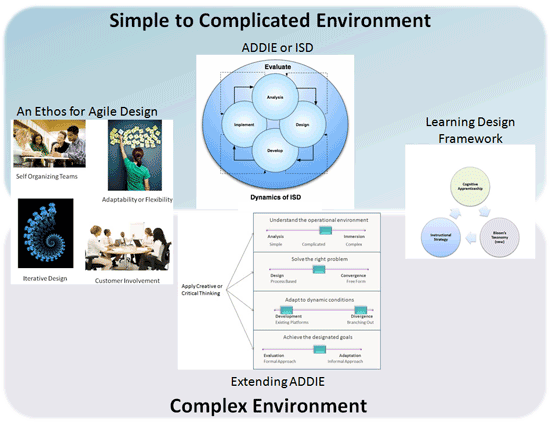
Deciding I need to tie four instructional design models together (ADDIE, Agile Design, Learning Design and an Extension for ISD), I created this brief description - A Framework for Designing Learning Environments.

6.07.2010

Instructional Design Framework

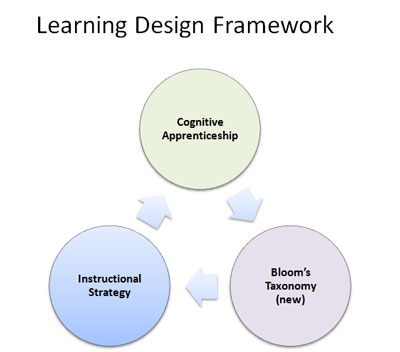
Instructional Design Framework

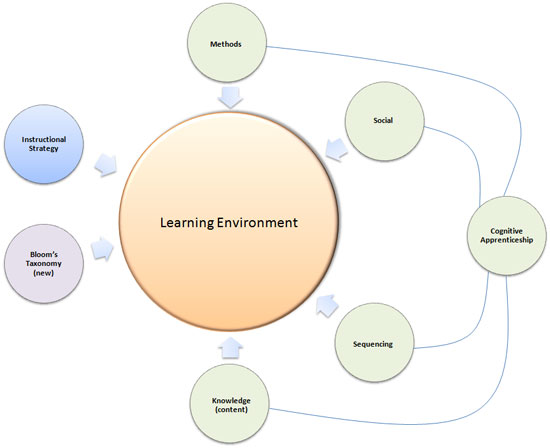
I added a new section to my Instructional Design site — a Framework to aid in the process for creating learning environments. It is located at Instructional Design Framework. It contains two excel workbooks to aid in the design process. Let me now what you think of it and perhaps what sort of framework you use in your design and development efforts.

Learning Design Framework

5.25.2010

Outlook for the Learning and Training Profession

There is an interesting infographic showing that Education/Training Consultants is one of the Best Jobs in America. It is based on the Bureau of Labor's Statistics Occupational Outlook Handbook, 2010-11 Edition. In fact, if you go to the Bureau of Labor's page on Human Resources, Training, and Labor Relations Managers and Specialists, it reads in part:

Employment is expected to grow much faster than the average for all human resources, training, and labor relations managers and specialists occupations. College graduates and those who have earned certification should have the best job opportunities. Overall employment is projected to grow by 22 percent between 2008 and 2018, much faster than the average for all occupations.

Some of the reasons listed for the projected growth of the learning/training profession includes:

  • Workers need to be trained on new legislation and court rulings that revise standards
  • Employers are expected to devote greater resources to job-specific training programs in response to the increasing complexity of many jobs and technological advances
  • As highly trained and skilled baby boomers retire, there should be strong demand for training and development specialists to impart needed skills to their replacements

But as we all know, the learning/training profession lost a number of jobs due to the recent economic woes — the report even indirectly acknowledges this:

Like other workers, employment of human resources, training, and labor relations managers and specialists, particularly in larger companies, may be adversely affected by corporate downsizing, restructuring, and mergers; however, as companies once again expand operations, additional workers may be needed to manage company growth.

Yet, it seems we sometimes take the biggest hits and are often the last to be called back to the workforce. Why? The biggest reason is that we often fail to directly address problems that impact the organization's performance. Managers in line departments want people who can solve some of their problems. In most cases they are not worried about ROIs or other fancy formulas — they simply want the problem to go away. Every problem that disappears is one less task they have to spend time on. Yet when given some of the simplest training problems we often go astray and rather than delivering a solution, we deliver some cute learning program that offers no real impact.

What are you doing today that shows your real worth to the organization?