5.28.2008

Training, mLearning, eLearning, Pay, & Blogs

Many Orbs

Management in formation - People Management

Inside one of the buildings, you might have found the eminent leadership academic John Alban-Metcalfe. He's giving a lecture to an assemble "some of the worst examples of leadership can come at the top of organisations", and citing such sources as Charles Handy while proceeding to debunk the myth of the charismatic leader.

Breaking Down mLearning - mLearning Hub

At the highest level we can separate mLearning into learning applied to mobile devices inside the classroom and those outside the classroom. Please note I realize the simple fact that something that is mobile means it could easily move in or out of the "classroom", however there is an important distinction between the two. Also see, iPods for Learning.

Teaching in the digital world, part I: technology is not always your friend - Science Blogs

Teaching an on-line course turned out to be as much a learning experience for me as it was for my students. Now, it's time to step back and reflect on what was learned.

Six Dangerous Myths About Pay - Conde Nast

Portfolio Off-price clothing retailer Men's Wearhouse pays higher-than-average wages and invests extensively in training. These unusual moves let it reduce turnover and compete on customer service, superior product knowledge, and sales skills - advantages that rivals can't easily copy.

Beyond Blogs - Business Week

Workers can fritter away hours on YouTube. They can use social networks to pillory a colleague or leak secrets. That's the downside, and companies that don't adapt are sure to get lots of it.

But there's an upside to the loss of control. Ambitious workers use these tools to land new deals and to assemble global teams for collaborative projects. The potential for both better and worse is huge, and it's growing - and since 2005 the technologies involved extend far beyond blogs. So our first fix is to lose "blogs" from our headline. The revised title: "Social Media Will Change Your Business."

5.26.2008

Video Games, mLearning, Activity Centered Design, & Web Users

Seattle Folk Festival

Video games can make us creative if spark is right - e! Science News

Video games that energize players and induce a positive mood could also enhance creativity, according to media researchers. However, the study also finds that players who were not highly energized and had a negative mood, registered the highest creativity. "You need defocused attention for being creative," said S. Shyam Sundar, professor of film, video and media studies at Penn State. "When you have low arousal and are negative, you tend to focus on detail and become more analytical."

"The key is to generate emotion," explained Sundar. "Ideally, a good teacher can energize the class and make them much more emotionally invested through presentations, guest lectures, and group discussions. Video games can help achieve that in an already simulated way."

Create Mobile Websites with Wirenode - Mobile Learning

Wirenode incorporates media and interactivity, which may even be uploaded by the user, and there's even an analytics tool for users who like to see how many visitors/students are checking out their mobile site.

Design - Human Centered Design vs Activity Centered Design? - eCube

The "listen to your users" produces incoherent designs. The "ignore your users" can produce horror stories, unless the person in charge has a clear vision or Conceptual Model for the product. The person in charge must follow that vision and not be afraid to ignore findings. Yes, listen to customers, but don't always do what they say.

Web users 'getting more selfish' - BBC

Instead of dawdling on websites many users want simply to reach a site quickly, complete a task and leave. Success rates measuring whether people achieve what they set out to do online are now about 75%, said Dr Nielsen. In 1999 this figure stood at 60%. The designs have become better but also users have become accustomed to that interactive environment.

Web users were also getting very frustrated with all the extras, such as widgets and applications, being added to sites to make them more friendly.

5.22.2008


Checking out animoto

Blogging--It's Good for You - Scientific American

Scientists (and writers) have long known about the therapeutic benefits of writing about personal experiences, thoughts and feelings. But besides serving as a stress-coping mechanism, expressive writing produces many physiological benefits.

We're all Einsteins now - New Zealand Herald

The ability to think in abstract terms underpins the scientific, material and, arguably, moral advances of modern society.

Visual Architecture: The Rule of Three - Digital Web

Don't flame me, bro' - New Scientist

People can vastly overestimate their ability to communicate unambiguously by email in that we find it hard to take another person's perspective when communicating electronically. Similarly, a study found that people tend to interpret emails more negatively than other forms of communication, making them even more likely to respond aggressively.

Older Brain Really May Be a Wiser Brain - New York Times

The aging brain is simply taking in more data and trying to sift through a clutter of information, often to its long-term benefit.

5.18.2008

Adaptable Workforce, Manufacturing, & Paths vs Hierarchies,

thistle seeds.JPG

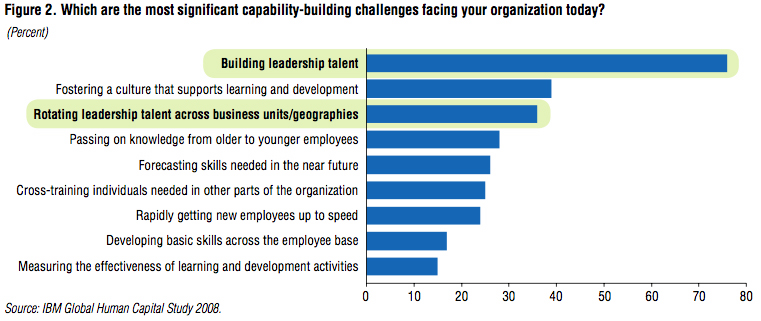
Unlocking the DNA of the Adaptable Workforce - IBM (executive summary)


Click to enlarge

Developing the workforce is the prime ingredient for an organization's success.

"As any firm that has attempted to transform its workforce to meet changing conditions will attest, the journey is difficult and littered with obstacles. Understanding key workforce performance challenges and identifying the leading practices companies are using to overcome them have become central focus areas." - IBM

download the complete paper

Back to Basics - Metropolis

In our rush to build a knowledge economy we forgot that we need a backbone.

"Manufacturing is still more relevant to long-term economic development than glitzy museums or massive sports stadiums." - Joel Kotkin

Think about paths instead of hierarchies - Signal vs. Noise

While this short post is about web navigation, the same principles apply to all forms of knowledge in the learning and development field.

"Instead of thinking in terms of hierarchy or up-front structure, I think it's better to work with paths. A path is a line that goes from a starting point A to an accomplishment B." - Ryan

5.17.2008

Development Ratio, mLearning, Change, & Feedback

Glass Bridge

Recent Survey shows 36:1 development ratio for ILT - Bryan Chapman

  • Front-End Analysis (Data Collection, Working with SMEs) = 13% (4.8 hours)
  • Instructional Design (Objectives, Outlining, Content Development) = 13% (4.6 hours)
  • Lesson Plan Development = 11% (3.8 hours)
  • Creation of handout material = 8% (3 hours)
  • Student Guide Development = 20% (7.2 hours)
  • PowerPoint Development = 21% (7.6 hours)
  • Test and Exam Creation = 8% (2.8 hours)
  • Other Tasks = 6% (2.3 hours
Mobile in 5 Paragraphs - Learnlets
Mobile learning is not about courses on a phone. mLearning is where we really bring home the message: 'It's not about learning... it's about doing", because while there are learning implications for mobile devices, it's really about performance support.

Can You Become a Creature of New Habits? - New York Times
Researchers in the late 1960s discovered that humans are born with the capacity to approach challenges in four primary ways: analytically, procedurally, relationally (or collaboratively) and innovatively.

What Behavior Do You Want to Change? - Business Week
When we began Nathaniel's exercise, our military friend chose: "When I become less judgmental. . ." as his behavior to change. I was skeptical about his sincerity and thought his participation in the exercise would be interesting to observe. True to my expectations, the first time around he coughed and grunted a sarcastic comment rather than talk about a real benefit.

Research Report on Feedback - Will at Work learning
This seminal research reviews how to give learners feedback, written in a way that puts feedback in perspective, that goes deep into the fundamentals to give readers clear mental models for how feedback works.

5.03.2008

Cognitive Age, Training, Memory, Instructional Technologies, & Captcha

The Cognitive Age - New York Times
We're moving into a more demanding cognitive age. In order to thrive, people are compelled to become better at absorbing, processing and combining information. The globalization paradigm emphasizes the fact that information can now travel 15,000 miles in an instant. But the most important part of information's journey is the last few inches - the space between a person's eyes or ears and the various regions of the brain.

The globalization paradigm leads people to see economic development as a form of foreign policy, as a grand competition between nations and civilizations. These abstractions, called "the Chinese" or "the Indians," are doing this or that. But the cognitive age paradigm emphasizes psychology, culture and pedagogy - the specific processes that foster learning.

Is the grass greener on the other side of the pond? - Training Zone
We're fascinated by the American training scene. Is their training - particularly elearning - bigger, brasher, better? Neil Lasher reports that the USA is just as fascinated by what is happening here! So, is the grass greener on the other side of the pond?

Memory Training Shown to Turn Up Brainpower - New York Times
Although the control groups also made gains, presumably because they had practice with the fluid intelligence tests, improvement in the trained groups was substantially greater. Moreover, the longer they trained, the higher their scores were. All performers, from the weakest to the strongest, showed significant improvement.

Instructional Technologies in Human Resource Development: Impact, Models, and Changes - International Journal of Instructional Technology and Distance Learning
An introduction to instructional technologies that can be used in human resource development (HRD)

Study Suggests Math Teachers Scrap Balls and Slices - New York Times
The students who learned the math abstractly did well with figuring out the rules of the game. Those who had learned through examples performed little better than might be expected if they were simply guessing. The problem with the real-world examples, Dr. Kaminski said, was that they obscured the underlying math, and students were not able to transfer their knowledge to new problems.

We still believe there is human involvement - Nicholas Carr
"Captcha" is the official term for those wavy strings of numbers and letters that you have to decipher before setting up an online email account or gaining access to other types of web sites. The acronym, coined by someone at Yahoo a few years back, stands for Completely Automated Public Turing Test to Tell Computers and Humans Apart.

4.28.2008

Decisions, Design, Wikis, Mistakes, & Innovation

Decision Making: Is It All 'Me, Me, Me'? - Science Daily
People act in their own best interests, according to traditional views of how and why we make the decisions that we do. However, psychologists at the Universities of Leicester and Exeter have recently found evidence that this assumption is not necessarily true. In fact the research shows that most of us will act in the best interest of our team -- often at our own expense.

Down with Innovation - ID Magazine
Design is now so important, it seems, that designers can no longer be trusted with it, and to make it absolutely clear that control has moved into someone else's hands, design needs to be given a fancy new name. Call it design thinking. Call it innovation. Everyone loves design but no one wants to call it design.

No Rest for the Wiki - Business Week
The online tools for building collective info banks are making deeper inroads in corporations and rewriting the rules of collaboration. Although Intel's wiki ruffled feathers - some employees don't like being edited by colleagues, especially those further down the org chart - Intelpedia caught on.

Are You an Enduring Organization? - Bersin & Associates
There was the IBM PC Junior, the RT-PC, the 9370 Minicomputer, and many more. These products, often the results of years of R&D, were announced with flourish and fanfare. When they failed, IBM was clearly disappointed. But the leaders of these products were not fired or demoted - rather they were forced to "learn from these mistakes" and go on and make them better.

The World's 50 Most Innovative Companies - Business Week
The World's Most Innovative Companies, a collaboration with the innovation practice of the Boston Consulting Group, is our most global list ever. It's also determined by a broader set of data than in the past.

4.20.2008

Encyclopedia, eLearning, coherence, Media, & Training

Encyclopedia Britannica Now Free For Bloggers - TechCrunch
You can get access to the online version for free through a new program called Britannica Webshare - provided that you are a "web publisher."The definition of a web publisher is rather squishy: "This program is intended for people who publish with some regularity on the Internet, be they bloggers, webmasters, or writers. We reserve the right to deny participation to anyone who in our judgment doesn't qualify."

Elearning: Is it time to party? - training zone
Although the general trend in usage in elearning is up, the composition of what makes up the figures is changing - less protracted periods of self-study; elearning is more real time, more rapid and more collaborative.

Coherence or Interest: Which is most important in online multimedia learning? - Australasian Journal of Educational Technology
Adding approximately 50% extra interesting but irrelevant information to a multimedia treatment did not result in lower achievement on a post-test as would bepredicted by the coherence principle (cognitive load). In authentic learning settings, interest may mitigate the effects of the coherence principle. Via Stephen Downes.

Research: the differences between media and technology - Rob Wright
Technology is more than just the media appliances used to deliver content. Technology also includes the pedagogy guiding that use of the media; it includes the teaching strategies driven by stated objectives; it drives toward desired outcomes, using a healthy mix of experiences, activities, and tasks. It mingles collaboration with reflection.

Best Methods for Product-Based Training - Chief Learning Officer
Training can be categorized into the following levels:

  • Awareness - need to know that an aspect of a product has changed, such as an e-mail or a letter.
  • Knowledge - speak about the basic features of a product, such as a blend of an e-mail and Web interaction.
  • Understanding - talk about the product and relate it to the needs that they're hearing from a client, such as a classroom.
  • Skill - coaching and mentoring in an actual sales situation, as the classroom is still an artificial, simulated environment.

4.14.2008

eLearning, Informal Learning 2.0, Wikipedia, Wisdom, KM, & Strategy

Update from ASTD TechKnowledge - Rapid eLearning News
"Surprisingly, everyone wanted to bad-mouth E-Learning, but no one bothered to stop and ask Jennifer to tell us more about why it was working so well for her." Effective management methodology: be sure management drives the process and only do what works!

Informal Learning 2.0 Fieldbook - Jay Cross
Join the Fieldbook project. People do not read un-books; they participate with them. Participants choose how deep they want to explore a topic.

Wikipedia breeds 'unwitting trust' says IT professor - Computer World
Professor Lichtenstein says the reliance by students on Wikipedia for finding information, and acceptance of the practice by teachers and academics, was "crowding out" valuable knowledge and creating a generation unable to source "credible expert" views even if desired. An expert is held accountable if they make a mistake but no one is held accountable for the information available on Wikipedia.

The Wisdom Scorecard, Monika Ardelt
Monika Ardelt, a sociology professor at the University of Florida, developed a questionnaire that attempts to assess how wise people are. The questionnaire contins 39 questions in three dimensions - cognitive, reflective, and affective. Once you have completed the questions, you can see your wisdom score.

The abuse of language - Cognitive Edge
Once upon a time people in Information Management decided that they wanted a cool new name or two. Taxonomy was becoming Taxidermy so they absconded with Ontology and twisted its meaning.

In Pictures: How To Unlock Your Company's Creativity - Forbes
Innovation lurks within myriad nooks and crannies of any company--from the receptionist to the head of information technology. While running a full-fledged democracy is impractical, employees at every level should have a way to share their ideas.

Strategy On The Front Line - Forbes
If you have an organization headed by a man or a woman who has a clear ideology, and everyone else can see that he or she is just not prepared to compromise, it is a lot easier for that organization to decentralize decisions because everyone knows certain rules will not be broken.

4.13.2008

Left/Right Brain, ISPI, Working Memory, Newspapers, & Cognitive Dissonance


Split brain behavioral experiments

To reduce the severity of his seizures, Joe had the bridge between his left and right cerebral hemisphers (the corpus callosum) severed. As a result, his left and right brains no longer communicate through that pathway.

Let Computers Compute. It's the Age of the Right Brain. - New York Times
Although popularized in the 1980s by the artist Betty Edwards in her book "Drawing on the Right Side of the Brain," the right-brain-left-brain dichotomy originated with the research of the American biologist Roger W. Sperry in the 1960s.

HPT Practitioner Podcast contest for ISPI - Guy Wallace
Guy Wallace has created 21 Video Podcasts for an "HPT Practitioner Podcast" contest for ISPI. Hopefully many others will also create some and add them to Google or YouTube and then create a post at ISPI's "HPT Connections"(free to anyone - dues paying members or not) and embed the code to add them to this new Social Network site. The "group page" for these Podcasts with info about the contest and how anyone can participate is here. The Podcasts are available on Google Video too. Just search under "HPT Practitioner Podcast." Guy also has a couple of posts about the ISPI speakers: Marc Rosenberg and Don Tosti.

Working Memory Has Limited 'Slots' - Science Daily
The evidence shows that working memory acts like a high-resolution camera, retaining three or four features in high detail. Those features allow the brain to link successive images together. However, while most digital cameras allow the user to choose a lower resolution and therefore store more images, the resolution of working memory appears to be constant for a given individual.

OUT OF PRINT - The New Yorker
The rise of the Internet, which has made the daily newspaper look slow and unresponsive; the advent of Craigslist, which is wiping out classified advertising -- have created a palpable sense of doom. Independent, publicly traded American newspapers have lost forty-two per cent of their market value in the past three years. Traditional media just need to realize that the online world isn't the enemy. In fact, it's the thing that will save them, if they fully embrace it.

No Web site spends anything remotely like what the best newspapers do on reporting. Even after the latest round of new cutbacks and buyouts are carried out, the Times will retain a core of more than twelve hundred newsroom employees, or approximately fifty times as many as the Huffington Post. The Washington Post and the Los Angeles Times maintain between eight hundred and nine hundred editorial employees each. The Times' Baghdad bureau alone costs around three million dollars a year to maintain. And while the Huffington Post shares the benefit of these investments, it shoulders none of the costs. Thus, bloggers merely "recycle and chew on the news."

And Behind Door No. 1, a Fatal Flaw - New York Times
The economist, M. Keith Chen, has challenged research into cognitive dissonance - the ability of people to rationalize their choices.